The Dawn War
Stakes If daylight continues expanding, the remaining safe settlements may be destroyed, but stopping it could require restoring the sun to its old and perhaps worse state.
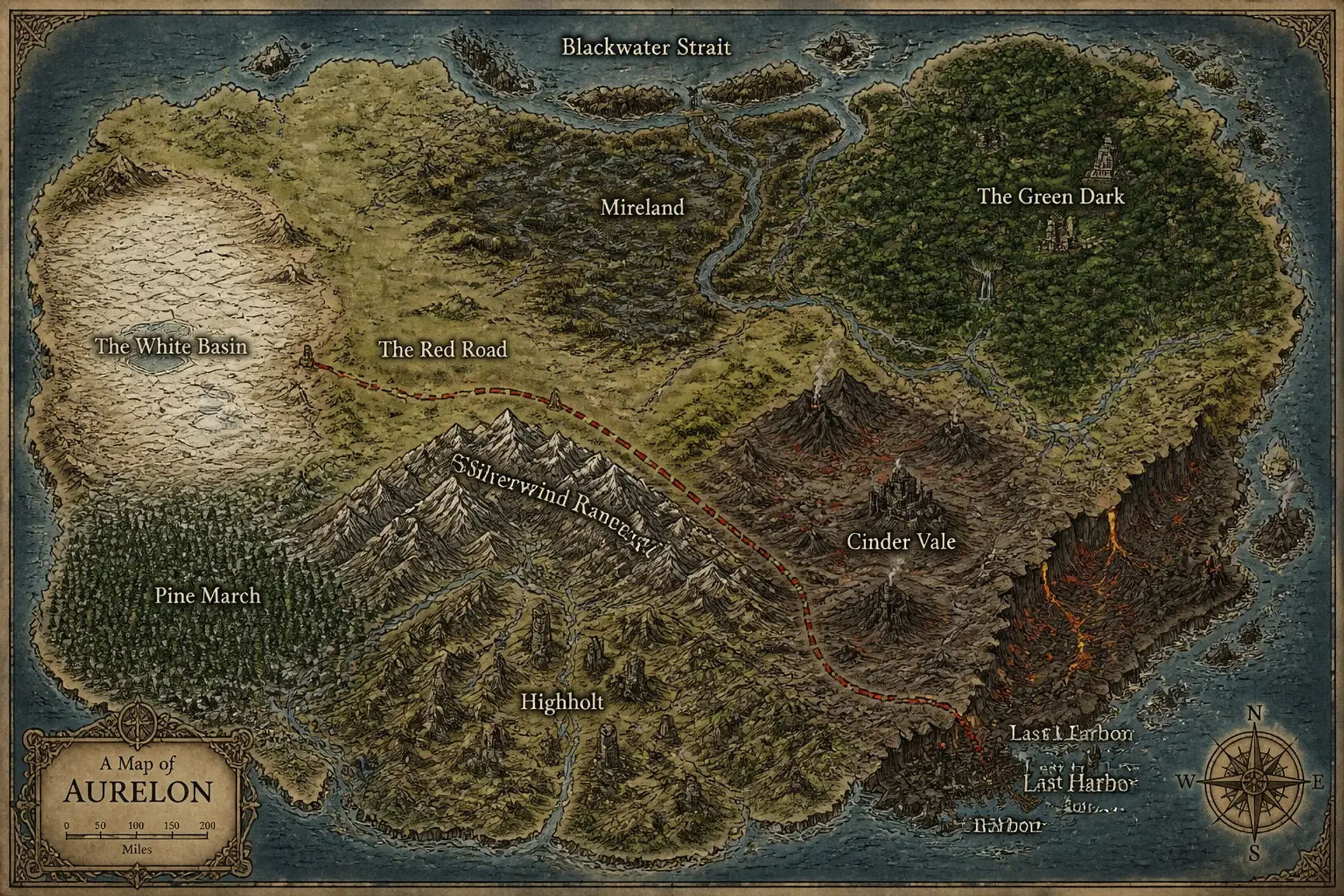
World Atlas·Sphere·The night is merciful, and every dawn takes something from you.
Source of salt, glass, and ancient sun relics · Salt desert
Hook
A buried city becomes visible only during the shortest noon, when its sealed vaults briefly open.
Nightreach is a scarred sphere beneath a changed sun. Daylight is no longer warmth but a consuming force that burns flesh, ruins crops, and strips away memory. Most people live by lantern, moon, and bell, traveling only during the dark hours between fortified settlements. Old roads cross salt plains, drowned forests, and abandoned cities where sun-killed shades still wander. Every ruler promises a cure, yet each depends on controlling the wells and relics that make darkness survivable.
Themes
Form · Sphere
Nightreach is a spherical planet with continents arranged around a sun-scorched equator and a habitable dark side.
Traversal
Travel is safest during night, by marked roads, guarded caravans, riverboats, and tunnels that connect fortified settlements.

Sphere
Magic
Low

Technology
Medieval

Death & Souls
Before Records
The Open Sun
The Long Burn
The White Years
Recorded History
The Night Compact
Present Day
The Broken Dawn
The Dawn War
If daylight continues expanding, the remaining safe settlements may be destroyed, but stopping it could require restoring the sun to its old and perhaps worse state.
The Well Roads
Control of underground rivers and night roads determines which communities eat, trade, and survive the coming bright seasons.
The Lantern Crown wants to unite the surviving settlements under one law and seize every major well.
The Ash Priests seek to restore the old sun, believing the present world is a punishment for human sorcery.
The Freeholds defend local rule and keep ancient routes open without submitting to any crown.
The Blackwheel League profits from smuggling water, relics, and forbidden daylight maps.
Stakes If daylight continues expanding, the remaining safe settlements may be destroyed, but stopping it could require restoring the sun to its old and perhaps worse state.
Stakes Control of underground rivers and night roads determines which communities eat, trade, and survive the coming bright seasons.
The world once lived beneath ordinary daylight, with thriving kingdoms and reliable harvests before the sun changed.
The altered sun scorched fields, emptied cities, and drove survivors into caves, forests, and heavy-walled settlements.
Humanity rebuilt around darkness, trading by starlight while rival rulers fought over wells, ruins, and sheltered roads.
Daylight has begun lasting longer and reaching farther underground, forcing old enemies to decide whether survival requires cooperation or conquest.
A sealed observatory sends a signal every night, though its astronomers died two centuries ago.
A border town's protective bell has stopped ringing, leaving its people exposed to returning shades.
A caravan carries a preserved memory said to reveal who changed the sun.
The Ash Priests offer to shorten the day, but their ritual requires extinguishing every lantern in three provinces.
The sun was altered by human magic to imprison something inside it.
Discovery · Old star charts show the Pale Sun was moved, not changed, and its original orbit was deliberately broken.
Impact · The world may be suffering from an ancient act of protection rather than a natural disaster.
The first victims of daylight remember a conspiracy among the world's oldest rulers.
Discovery · Sun-killed shades repeat the same unfinished sentence when brought near ancient observatories.
Impact · Their memories could identify the people who caused the Long Burn and reveal that some still rule from hiding.
The Ash Star is a moving key, not a celestial body.
Discovery · The Ash Star appears in different places on the horizon but always above a sealed ruin.
Impact · Following it could lead to the device that controls the length of day.