Small or Medium, chosen when you select this species
Common
Humanoid
Humanoid·Small or Medium, chosen when you select this species
Caninxa
Caninxa familiaris
Speed
30 ft.
Lifespan
Caninxa mature at about 15 years and commonly live 70 to 90 years.
Darkvision
60 ft.
Habitat
Plains
humanoid
dog folk
hound folk
plains
pack culture
scent
darkvision
diverse lineages
standard PC
SizeSmall or Medium, chosen when you select this species
Speed30 ft.
LifespanCaninxa mature at about 15 years and commonly live 70 to 90 years.
Creature TypeHumanoid
Darkvision60 ft.
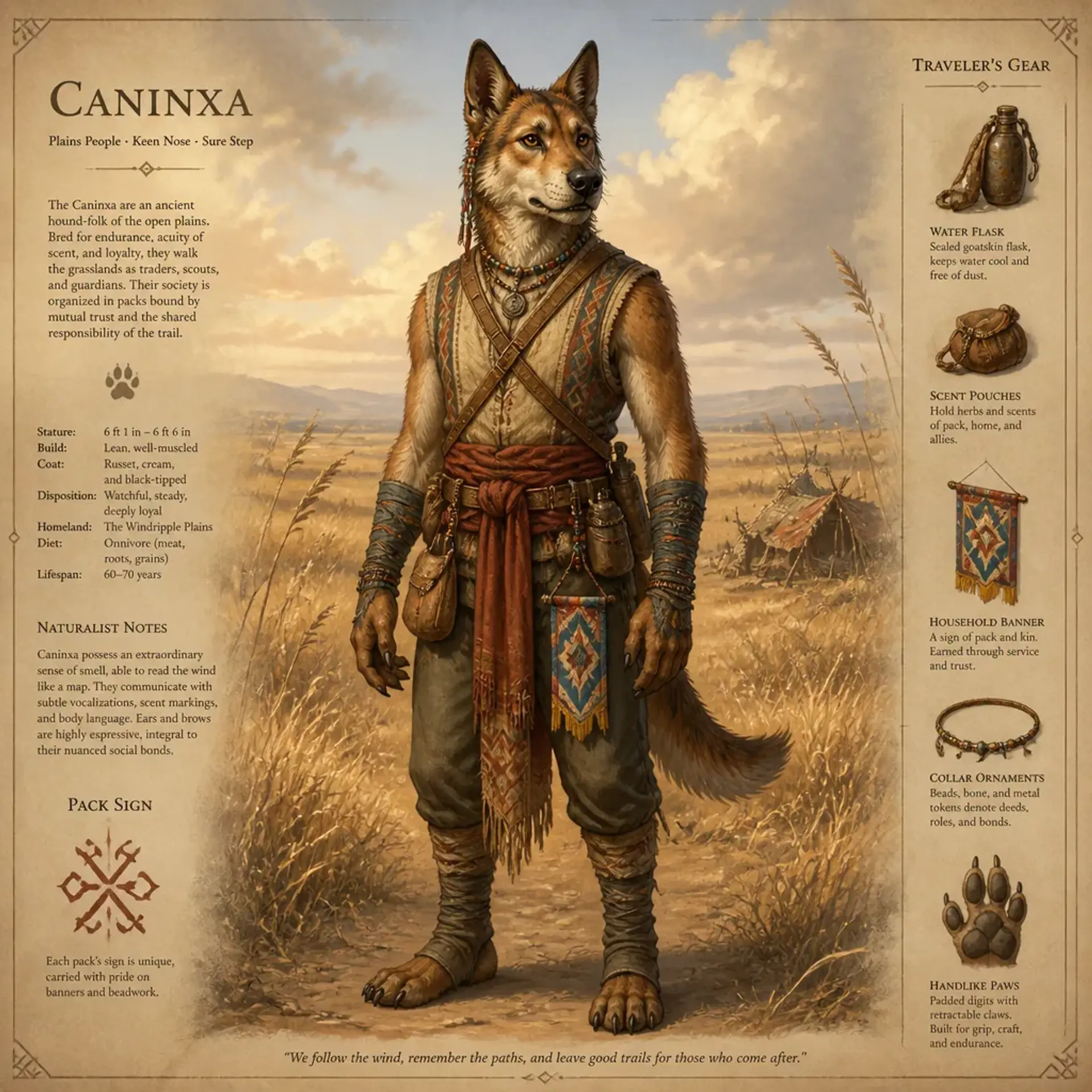
Caninxa arrive like weather over the grasslands: ears lifted, noses testing the wind, and eyes already adjusting to the dark. They are hounds, shepherds, wanderers, and watchkeepers, bound by fierce loyalty but drawn toward every unfamiliar road. A Caninxa adventurer may be a cheerful caravan outrider, a solemn village guardian, an irrepressible treasure hunter, or a lone exile searching for the scent of home.
Physical Description
Caninxa are humanoids with the recognizable anatomy of upright dogs and hounds. Their heads have slightly elongated muzzles, powerful jaws, prominent canine teeth, mobile ears, and expressive brows. Their bodies are covered in fur ranging from close and sleek to thick and weatherproof, with coats that may resemble the patterns and textures of shibininu, husky, poodle, setter, mastiff, terrier, or countless blended lineages. Their paws are handlike enough for tools and weapons, though padded palms and blunt claws remain visible. Each Caninxa possesses scent glands comparable to those of mundane dogs, allowing them to recognize individuals, territory, illness, fear, and many subtle environmental changes. Their diversity is celebrated rather than categorized into a rigid hierarchy, and two members of the same household may look radically different.
Society & Culture
Caninxa society is organized through households, traveling packs, and chosen kinships. The word pack does not imply a strict chain of command. It describes a circle of mutual obligation whose members share food, warnings, labor, and stories. Names, greetings, and farewells carry great importance, while scent is used as a private emotional language and a practical means of recognition. Caninxa are skilled at reading posture, tone, breath, and movement, and many consider spoken words only one part of a conversation. Festivals often feature long-distance races, scent puzzles, night markets, communal singing, and the renewal of family banners. Hospitality is sacred, but guests are expected to respect household boundaries and never mock another person's instincts.
Religion & Alignment
Caninxa commonly honor deities and spirits associated with roads, hearths, guardianship, the hunt, wind, loyalty, and the moonlit grass. Their faith often includes scent offerings, spoken remembrances, and communal night watches. Most Caninxa lean toward compassionate or principled behavior because cooperation is central to survival, but wandering traditions produce many independent, mischievous, and fiercely individualistic members. Alignment is never dictated by pack loyalty. A Caninxa may protect a community, challenge its customs, or leave it entirely when conscience demands.
Homelands & Architecture
Caninxa homelands are built around movement, visibility, and shared air. Their oldest settlements are low, broad compounds arranged around communal courtyards, with wind towers, shaded sleeping dens, elevated lookout platforms, and walls designed to carry spoken calls. Traveling households use collapsible hide shelters, scent-marked trail stones, and brightly woven banners that announce hospitality from a distance. Permanent towns often preserve several open lanes through their center so residents can run, gather, and follow a scent without obstruction.
Relationships With Other Peoples
Caninxa tend to form strong relationships with individuals rather than judging entire peoples. They are often valued as guides, scouts, couriers, investigators, and guardians, though their directness can be mistaken for nosiness or suspicion. They are comfortable among humans and other adaptable peoples, admire disciplined communities, and are fascinated by beings whose bodies carry unusual scents or no scent at all. Caninxa culture distinguishes between solitude and abandonment. The first can be restorative, while the second is considered a serious social wound.
Visual sheet
Turn Caninxa into a sheet
A high-res, share-ready sheet you can post or print.