Small or Medium, chosen when you select this species
Common
Humanoid
Humanoid·Small or Medium, chosen when you select this species
Murkkin
Rattus civitatis, a scholarly name rarely used outside universities
Speed
30 ft.; climb difficult urban surfaces without extra movement when both hands are free
Lifespan
Murkkin mature around age 14 and commonly live 70 to 90 years, though elders who remain active in city life sometimes reach a century.
Darkvision
60 ft.
Habitat
Dense urban environments, especially old cities with layered streets, extensive drainage systems, crowded markets, abandoned infrastructure, and thriving informal communities.
beast-folk
urban
nimble
community-minded
scavenger
city-dweller
SizeSmall or Medium, chosen when you select this species
Speed30 ft.; climb difficult urban surfaces without extra movement when both hands are free
LifespanMurkkin mature around age 14 and commonly live 70 to 90 years, though elders who remain active in city life sometimes reach a century.
Creature TypeHumanoid
Darkvision60 ft.
Murkkin are the hidden citizens of the world's oldest cities, small beast-folk who know which doors open, which bells warn of fire, and which powerful people lie about what lies beneath their streets. They are couriers, scavengers, architects, spies, healers, and keepers of communal memory. To travel with a Murkkin is to discover that every city has another city inside it, one built from favors, forgotten passages, rooftop gardens, and stories traded after midnight.
Physical Description
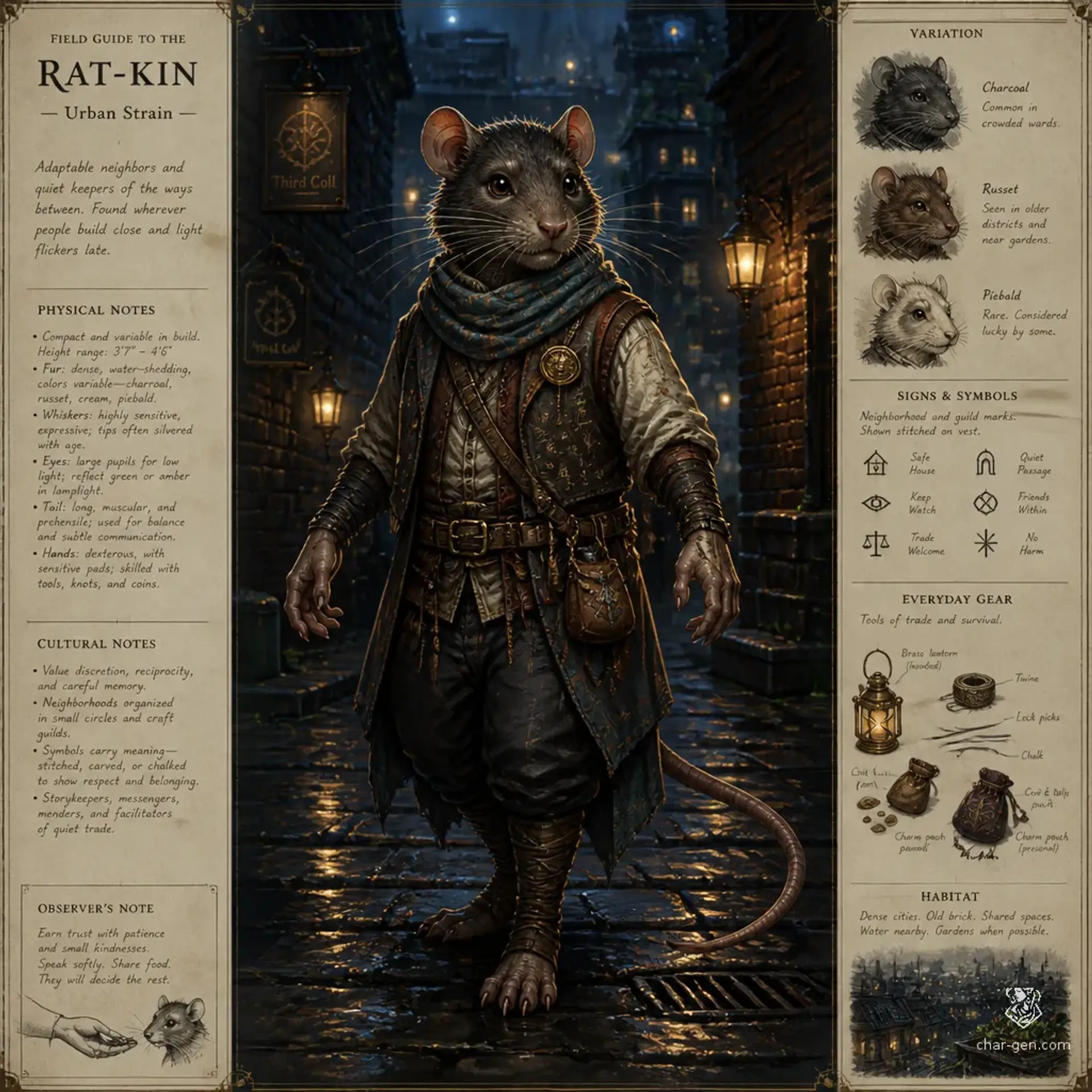
Murkkin are compact, highly variable beast-folk with rounded ears, mobile whiskers, dexterous hands, and long flexible tails. Their faces range from soft and mouse-like to sharp-featured and rat-like, while their coats may be charcoal, russet, cream, silver, brindled, or nearly white. Some possess prominent incisors, though these are usually concealed when they speak. Their eyes are adapted to low light and often reflect green, amber, or copper when caught by a lantern. Murkkin dress for movement, favoring layered vests, wrapped scarves, pocketed belts, soft boots, and garments marked with tiny clan or neighborhood symbols.
Society & Culture
Murkkin culture is neighborhood-based rather than kingdom-based. A person's first allegiance is usually to the people who fed them, taught them routes, or sheltered their family. They preserve history through oral recitations, coded murals, carved doorframes, food traditions, and scent-marked objects. Hospitality is serious business. Guests are given a meal, a safe place to sleep, and a warning about local dangers before anyone asks their name. Murkkin communities value competence over status, but they also celebrate clever jokes, elaborate festivals, rooftop music, and competitive storytelling. Their councils are informal by design, relying on trusted elders, trade representatives, household heads, and young people who know the newest routes through the city.
Religion & Alignment
Murkkin religion centers on household spirits, ancestor-memory, protective city gods, and the belief that every living community is connected by invisible paths of obligation. Many leave crumbs, coins, or whispered thanks near bridges, drains, ovens, and public fountains. Their ethics favor compassion, mutual aid, and practical freedom, so many are good or neutral, though ambitious city-climbers and revolutionary organizers can be fiercely chaotic. A Murkkin villain is rarely cruel without purpose. More often, they have decided that the web of society must be cut and rewoven by force.
Homelands & Architecture
Murkkin settlements are woven into the unused spaces of larger cities. Their homes occupy basements, attic networks, service tunnels, disused aqueducts, hollow walls, and connected courtyards. Rather than building monumental structures, they improve what already exists, adding foldable stairs, hidden alcoves, ventilation shafts, pulley lifts, scent-marked doors, and communal kitchens. A Murkkin district may be invisible to outsiders while remaining remarkably comfortable and well organized within.
Relationships With Other Peoples
Murkkin are often welcomed as neighbors and undervalued as citizens. They maintain close ties with working communities, street performers, messengers, laborers, shopkeepers, and travelers, while remaining wary of aristocrats, occupying armies, and institutions that redraw neighborhoods without consulting their residents. Dwarf-like peoples often respect Murkkin engineering, goblin-kin communities share their talent for salvage and improvisation, and taller urban cultures frequently rely on Murkkin couriers while pretending not to notice their influence. Murkkin diplomacy is patient, personal, and built on remembering who helped whom.
Visual sheet
Turn Murkkin into a sheet
A high-res, share-ready sheet you can post or print.