
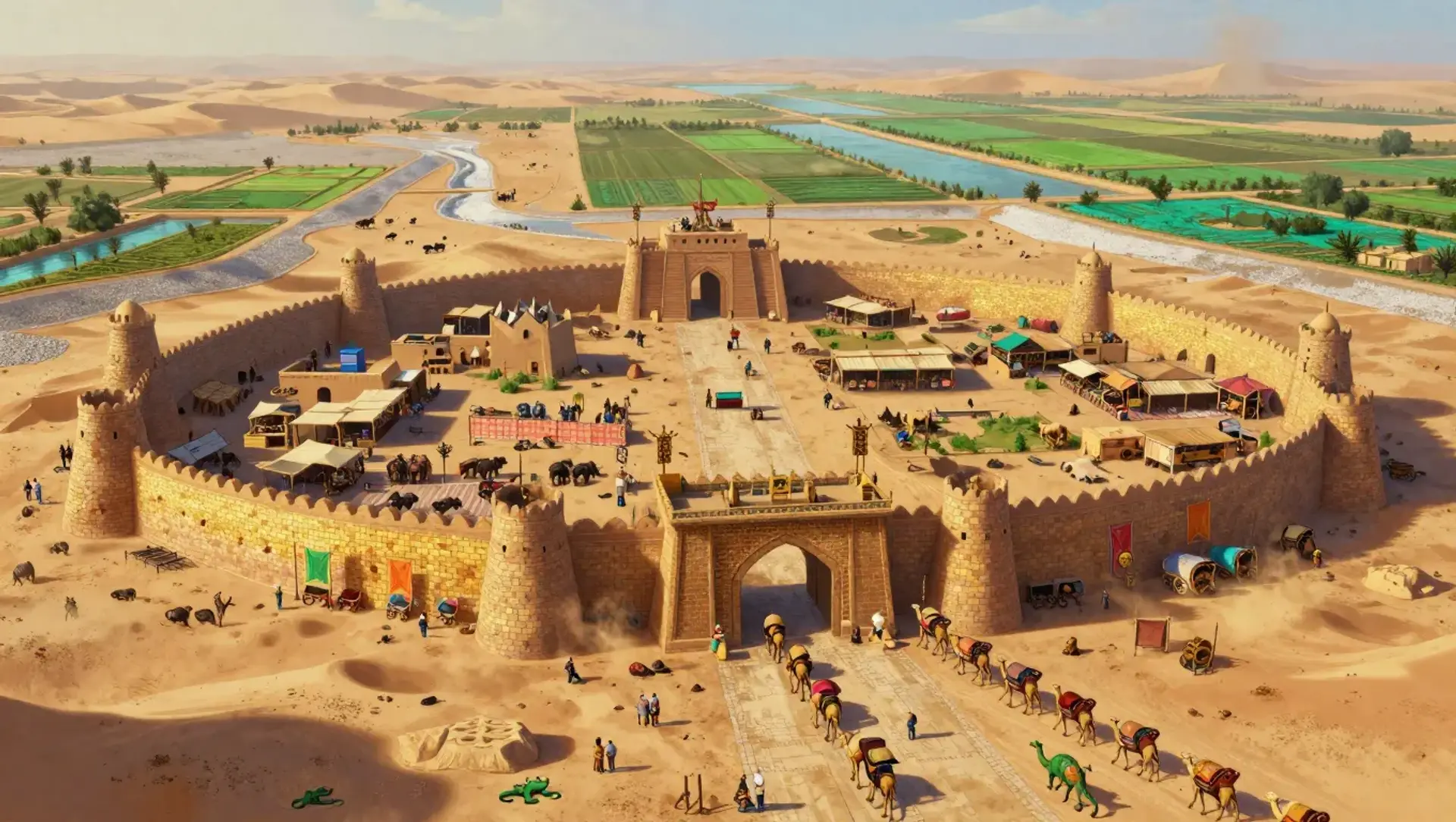
Al-Mahattah al-Kubra, The Great Junction
Al-Mahattah al-Kubra stands where the outer desert tracks narrow against the irrigated western edge of the Crown Oasis. Its walls contain a city built for caravans rather than residents, with broad turning lanes, covered wells, beast-yards, counting houses, and fortress-inns arranged in concentric rings. Merchants arrive seeking water, protection, and legal passage into Virdal Valley. They soon learn that the city’s greatest commodity is not shelter, but permission.
Al-Mahattah al-Kubra, The Great Junction
Every caravan stops here, and every drop of water leaves with a name attached.
“Al-Mahattah al-Kubra smells of hot leather, cardamom, dung smoke, and wet stone. Bells clatter from camel harnesses while customs gongs answer across the courtyards. Every gate is crowded with movement, yet the city feels watchful rather than welcoming. Water sellers shout beneath striped awnings, guards inspect axle-bolts and saddle seams, and dust hangs over the walls like a second sky. Nothing enters without being counted.”
Gallery
Connections
Geography
Culture
The city praises preparedness above generosity. A person who carries extra water, pays a fair handler, and keeps a written agreement earns more respect than someone displaying inherited wealth. Hospitality is sacred inside a guest-court, but hospitality ends sharply at the customs line. Locals distrust anyone who claims to be passing through unnoticed, because every unnoticed traveler represents danger, unpaid duty, or a stolen share of the Oasis’s water.
Al-Mahattah favors practical performance. Storytellers recite caravan epics from shaded platforms, musicians play reed pipes and hammered brass, and acrobats perform atop tethered wagons during market festivals. Beast-handling is treated as both craft and theater. Wealthy merchants commission painted route-cloths showing wells, stars, and border markers, while poorer travelers trade songs that encode warnings about bandits, corrupt inspectors, and unreliable water sellers.
History
Government
The enchanted customs scales are assigning abnormal water-debts to caravans, causing cistern levels to fall in districts that have paid their full assessments. Prefect Samira al-Hadid is concealing the problem while ordering more seizures.
The Quiet Bridle has begun moving people and contraband through beast-yard drainage channels. The Gatewardens want a public crackdown, while Water Ledger clerks fear that sealing the passages will rupture an old aquifer conduit.
Economy
Water is carefully rationed during late summer, and the city’s public cisterns depend on controlled flows from the Crown Oasis. Skilled animal handlers, honest scribes, and reliable guides are nearly as scarce. Any sudden shortage of one can delay an entire trade season.
Defenses
A disciplined force of customs guards, mounted patrols, wall sentries, and licensed caravan outriders. Their authority is strongest at the gates and weakest in the crowded bazaars, where merchants can bury a squad beneath witnesses, contracts, and competing claims.
Law & Order
- crime Level
- Moderate and highly organized. Street theft is uncommon near guarded caravanserai, while contract fraud, cargo substitution, bribery, animal theft, and water tampering are persistent threats.
- enforcement
- The Gatewardens patrol gates and market corridors, supported by licensed private guards. Inspectors rely on written declarations, witness marks, and enchanted seals. Enforcement is efficient when a crime threatens trade, but slow when powerful merchant houses are involved.
- typical Punishment
- Fines, confiscation of cargo, temporary license suspension, forced labor repairing walls or cisterns, and imprisonment in the Bastion cells. Water theft or scale tampering can lead to permanent banishment from the Crown Oasis routes.
Calendar of Events
Turn Al-Mahattah al-Kubra, The Great Junction into a sheet
A high-res, share-ready sheet you can post or print.