
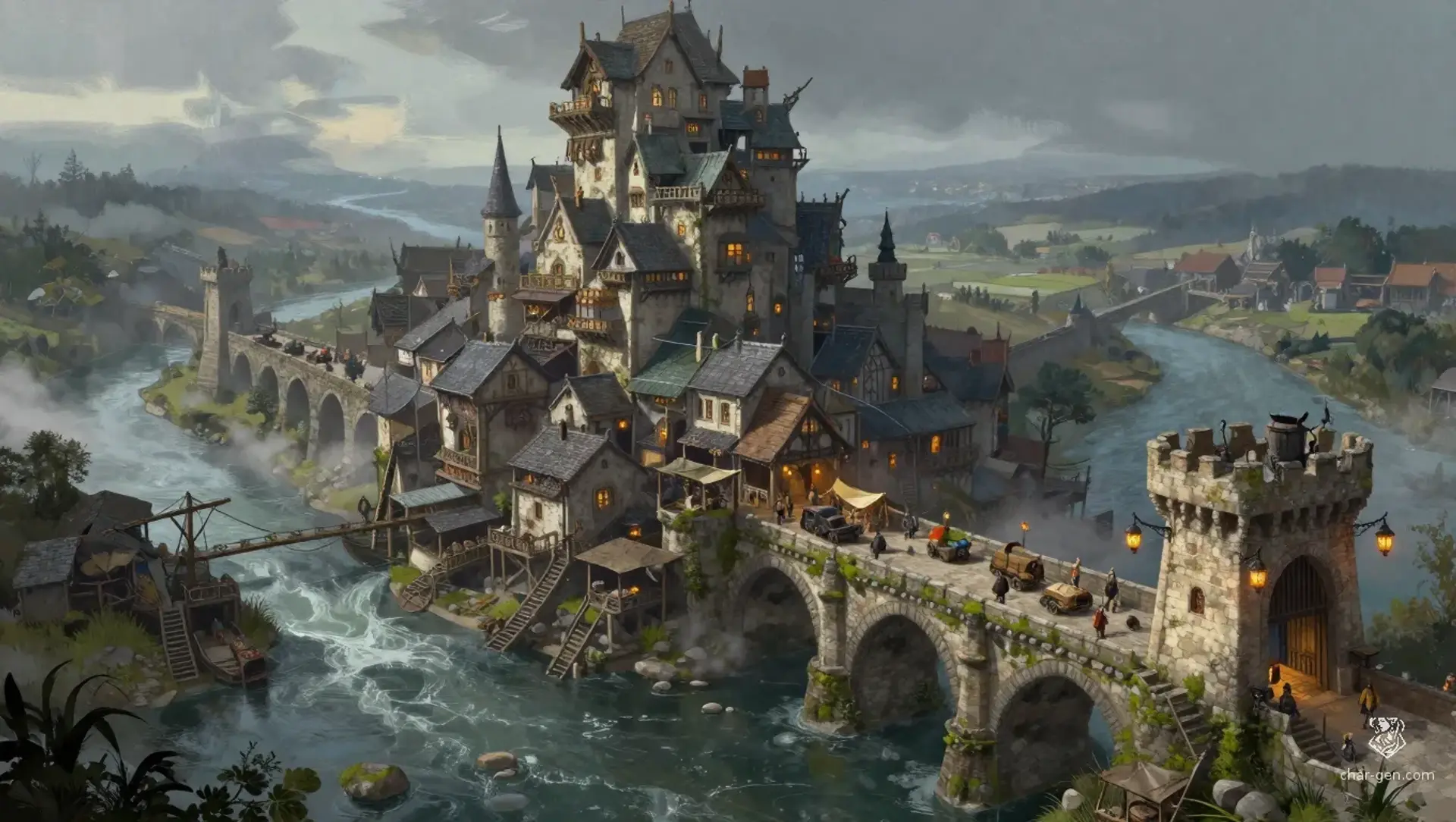
Bellwater
Bellwater is a village built entirely upon an old stone bridge spanning the slow, broad River Vey. Houses, workshops, shrines, and taverns rise above the roadway in cramped tiers, their upper floors leaning toward one another until the sky becomes a narrow strip. Two formidable towers guard the approaches and collect tolls. The village exists because this is the only reliable crossing for many miles.
Bellwater
A village where every doorstep hangs over the same road, and every toll hides an argument.
“Bellwater feels crowded, damp, and watchful. The river mutters beneath floorboards, carts groan over the crown of the bridge, and every window seems positioned to observe the road. Lanterns burn under covered walkways even at noon. Residents know who crossed, who paid, and who lingered. Outsiders are welcomed politely, then discussed from three different alleys before they reach the far tower.”
Gallery
Connections
Geography
Culture
Residents believe survival depends on knowing exactly what belongs to everyone and what belongs to no one. Hospitality is expected inside the village, but generosity is recorded and repaid. A person who causes trouble on the bridge endangers every household, so disputes are settled quickly, often by people who were never invited to speak. Privacy is treated as suspicious, though secrets are traded constantly.
Bellwater favors practical performances that fit narrow spaces. Puppet shows unfold from windows, fiddlers play beneath awnings, and storytellers compete to make travelers laugh before the far tower. Local children perform mock toll collections using painted wooden coins. The most respected artists are bridge masons who carve tiny faces and river scenes into lintels, supposedly honoring ancestors who kept the crossing standing.
History
Government
The central piers have begun shedding pale stone into the river, and the Order of the Sounding Line says the oldest span may fail within a year. Repairs require clearing occupied buildings, but the council refuses to admit the danger publicly.
Mara Venn has discovered that the original charter forbids tolls on local food, but she keeps collecting them because the council's debts are greater than anyone knows. Her flaw is not cruelty but an inability to surrender control once she believes disorder is near.
Economy
Fresh land is scarce, firewood is expensive, and clean water becomes difficult during river floods. Anything bulky must be hauled up from the banks by crane. The village can survive a bad harvest by controlling passage, but it cannot easily survive a prolonged closure of the road. Medicines, iron nails, and honest news are all more difficult to obtain than residents admit.
Defenses
A mixed watch of toll wardens, veteran bridge guards, and sworn household defenders. They train with crossbows, spears, clubs, and hooked poles designed for fighting on stairs or shoving attackers into the river. Most are loyal to Bellwater rather than its leader, which becomes a strength during honest danger and a liability during political disputes.
Law & Order
- crime Level
- Moderate, with theft, smuggling, intimidation, and occasional disappearances hidden beneath a reputation for order. Serious violence is uncommon on the roadway because there are too many witnesses, but the lower arches and maintenance paths are another matter.
- enforcement
- The Bridge Watch patrols the main road and towers while householders police their own stairwells. Toll disputes are handled quickly and harshly. Crimes involving council members often vanish into closed hearings, whereas crimes against travelers are punished publicly to protect Bellwater's reputation.
- typical Punishment
- Fines, seizure of goods, temporary confinement in a tower cell, or banishment from the bridge. Repeat offenders may be chained to a river barge and forced to work beneath the bridge during repairs. The council claims execution is unnecessary, though one hidden gallows remains in the west tower cellar.
Calendar of Events
Turn Bellwater into a sheet
A high-res, share-ready sheet you can post or print.