
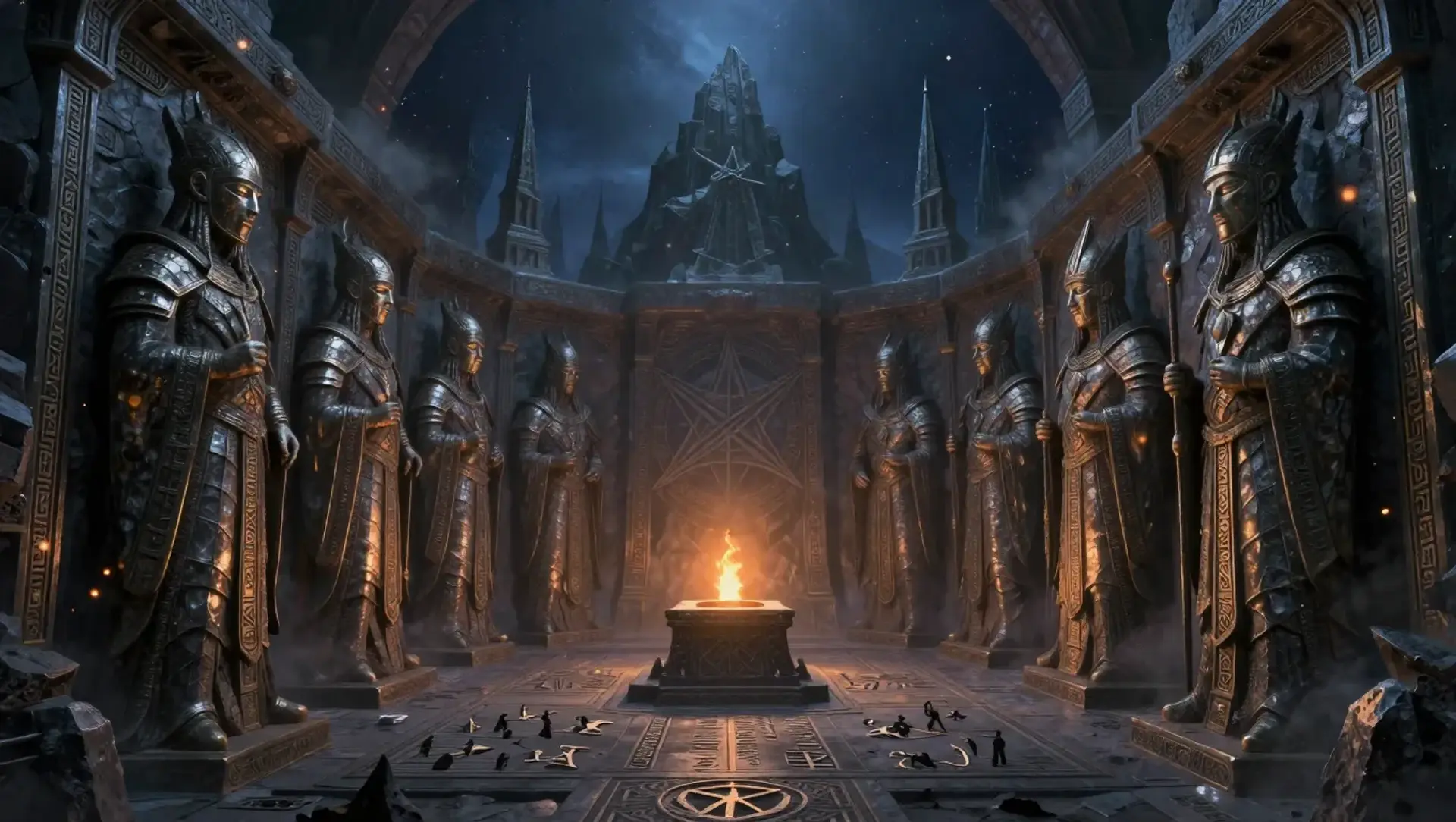
Morndinsamman
Origin
According to orthodox doctrine, Moradin struck the first spark in the formless dark and shaped the primordial stone into the seven divine offices. From that assembly came the laws of creation, battle, kinship, hidden earth, possession, death, and change. Each deity then helped fashion the dwarves, assigning every creature a role intended to preserve the balance of the Great Forge. Diirinka claims the story is incomplete: they say the first design included freedom, and that the other gods buried this fact after discovering that chosen purpose could rival divine command.
Cosmology
The universe is the Great Forge, established by Moradin and sustained by six lesser cosmic principles. Stone remembers, metal obeys, blood binds, battle proves, wealth tempts, death measures, and change disrupts. The mortal world is a workshop in which every creature is fashioned for a particular purpose. The gods do not commonly intervene because direct interference would invalidate the test of mortal vocation. Their distant attention is felt through dreams of furnaces, buried chambers, ancestral voices, and tools that seem to know their proper use.
Structure
The religion is organized as a network of clan-based priesthoods rather than a centralized church. Every major settlement maintains a Sevenfold Hall with seven connected chambers, though the chamber of Diirinka is often placed near an exit or left deliberately unfinished. Moradin's clergy hold senior authority in matters of law, construction, craft, and doctrine, while Gorm Gulthyn's judges possess independent power over death rites and accusations of betrayal. Berronar True-Silver's matrons mediate disputes between clans, Clangeddin Iron-Beard's war-priests oversee defense, Dumathoin's wardens control sacred mines and maps, and Abbathor's devotees operate as unofficial financiers and power brokers. Diirinka has no recognized hierarchy; its worshippers gather in temporary circles, traveling workshops, hidden roads, and moments of communal refusal. The Sevenfold Hall's rituals emphasize that the gods are not a family of equals but a machine of competing necessities, and that mortal life is the test by which the machine decides what may enter Erackinor.
Mortal Relations
The Morndinsamman are worshipped through clan temples, forge-shrines, ancestral halls, mine chapels, battlefield cairns, and guarded family hearths. Most dwarves honor the entire assembly while emphasizing the deity whose sphere best matches their vocation. Clerics and champions are expected to embody a divine function rather than merely profess belief. Moradin's priests organize craft and law; Clangeddin Iron-Beard's champions defend the community; Berronar True-Silver's devotees preserve families and traditions; Dumathoin's servants explore and steward the deep places; Abbathor's cults operate through private patronage and secret contracts; Gorm Gulthyn's clergy oversee burial, justice, and protective wards; and Diirinka's scattered cells aid fugitives, innovators, and those rejecting inherited roles. Public worship is formal and quiet, but private devotion is intense because every dwarf fears that the gods are measuring whether their life has served its proper end.
Afterlife
Erackinor is a sealed celestial fortress beneath a sky of black iron, where worthy dwarven souls are assigned eternal halls according to the purpose they fulfilled in life. Moradin judges whether a soul's work was completed; Berronar True-Silver receives the loyal and reconciles families; Gorm Gulthyn records every deed and pronounces final judgment. Souls that abandon, betray, or fundamentally fail their ordained duty are cast into the Menothjaal, a lightless maze of discarded tools, broken names, and unfinished tasks. Even there, Diirinka sometimes whispers paths toward transformation, though Gorm Gulthyn insists that redemption must be earned through truth.
Turn Morndinsamman into a sheet
A high-res, share-ready sheet you can post or print.