
The Concord of Ten
Origin
The Concord formed when Orun divided primordial reality into ten divine offices. Aurelion, Selvara, and Veyra became the great pillars of order, passage, and freedom; the other gods arose from the tensions between those principles. According to temple doctrine, the assembly exists not because the gods agree, but because no single divine purpose can sustain the mortal world alone.
Cosmology
Before time, Orun the First Measure established the laws of reality and divided the formless dark into sky, sea, stone, flame, and spirit. From the first conjunction of those principles arose the remaining gods. Aurelion governs the celestial order, Selvara maintains the passage between life and death, and Veyra embodies the wild potential that existed before law. The mortal world rests between divine absolutes, shaped by the competing purposes of the ten gods.
Structure
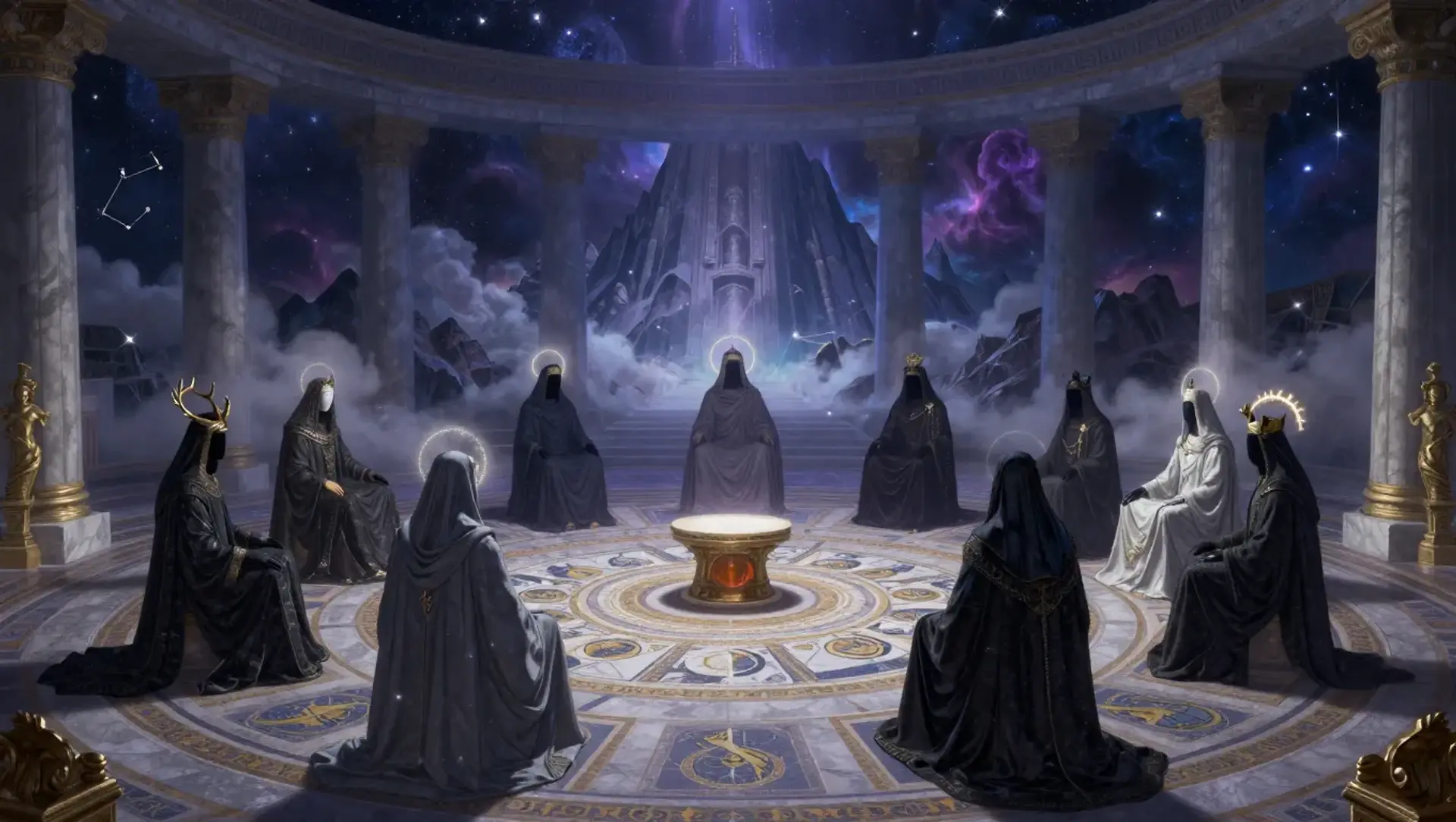
The religion is a decentralized concord rather than a single church. Each deity has an independent priesthood, sacred calendar, initiation tradition, and temple style, but major cities maintain Concord Houses containing ten shrines around a central empty altar representing the unresolved space between the gods. Clergy are ranked as Acolytes, Keepers, Ministers, and Exarchs. A seasonal council called the Synod of Lamps settles disputes among the more moderate temples, while the cults of Morvath, Kharza, and Nhalor generally reject its authority. Religious ceremonies often invoke multiple deities in sequence, reflecting the belief that mortal life exists between competing divine powers.
Mortal Relations
The pantheon is worshipped through separate temples, household shrines, mystery cults, civic orders, and wandering priesthoods. Most mortals honor several deities according to circumstance: Aurelion for law, Selvara for funerals, Ilyra for birth, Tharos for protection, and Lethara for learning. The gods rarely manifest directly, preferring omens, dreams, miraculous coincidences, and chosen champions. Clerics may serve one deity while acknowledging the legitimacy of the others, though extremist cults devoted to Morvath or Nhalor often seek to suppress rival worship.
Afterlife
The dead cross the Veil of Selvara, where their deeds are weighed beneath Orun's silent stars. Those who served a principle strongly are drawn toward a corresponding divine realm; the faithless wander the Grey Expanse until claimed by Nhalor, who preserves forgotten names. No soul is judged permanently, for Ilyra may return the worthy through birth, dream, or omen.
Turn The Concord of Ten into a sheet
A high-res, share-ready sheet you can post or print.