
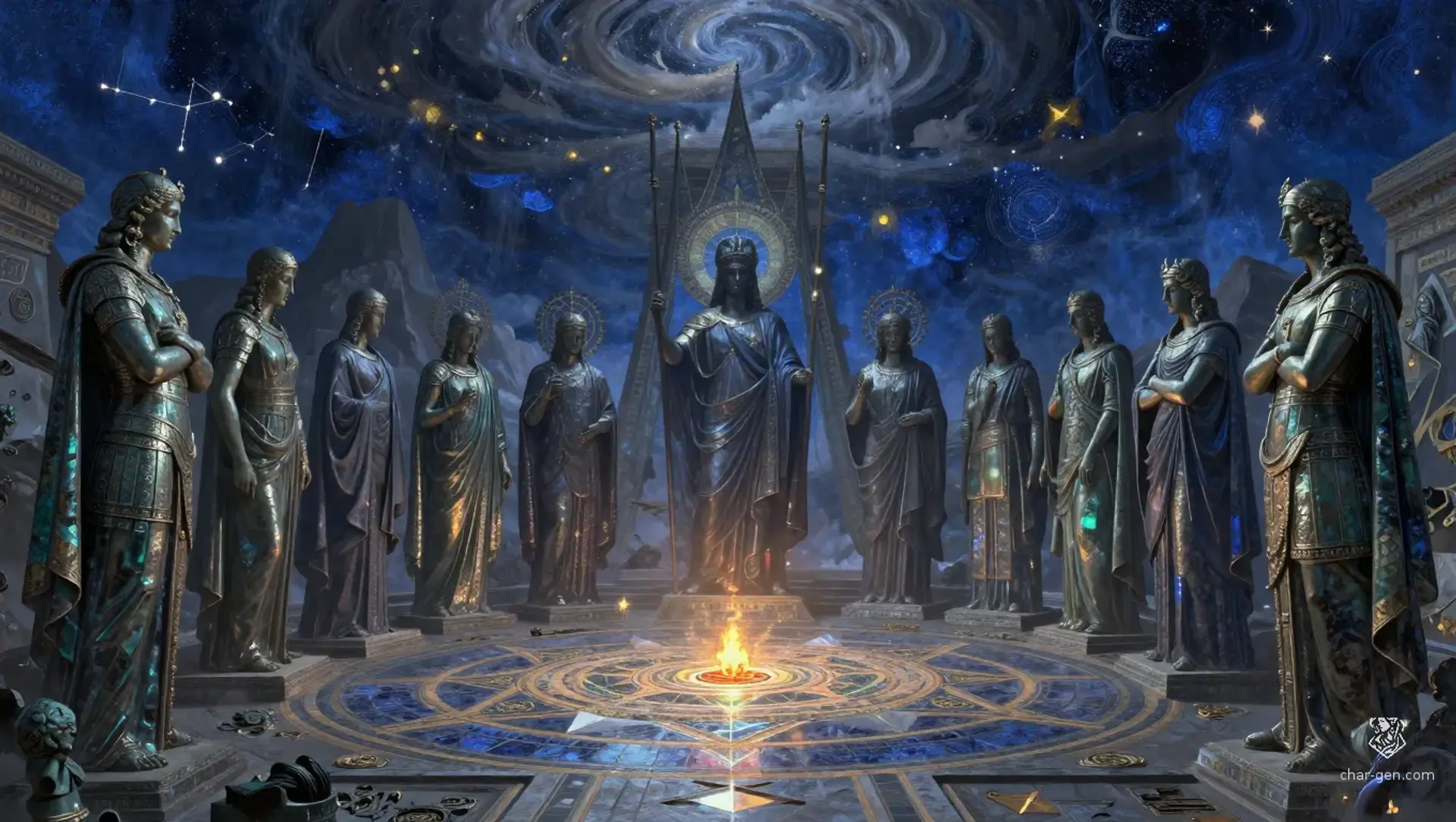
The Twelvefold Assembly
Origin
The pantheon claims that the first gods emerged when the sky, sea, earth, flame, death, desire, and wildness became conscious. Zeus, Poseidon, and Hades divided the cosmos after a primordial struggle, while Hera, Athena, Apollo, Artemis, Demeter, Aphrodite, Ares, Hephaestus, Dionysus, and Hermes established the laws, passions, crafts, and boundaries of mortal existence. Their myths disagree because each god preserves a different version of the founding conflict.
Cosmology
The universe began as a vast, dark potential that the Twelve shaped through contest and compromise. Zeus governs the sky and divine law, Poseidon the encircling sea, and Hades the depths below. Hera gives continuity to sovereignty, Athena gives form to wisdom, Apollo illuminates truth, Artemis guards the wild, Demeter sustains life, Aphrodite binds desire, Ares awakens conflict, Hephaestus crafts transformation, and Hermes carries all boundaries. The pantheon believes existence remains stable only because no deity can completely defeat the others.
Structure
The religion is organized as a loose sacred federation rather than a single church. Each deity has independent temples, priesthoods, mysteries, and holy days, but all major sanctuaries maintain a Council of Twelve Seats. The council arbitrates disputes, coordinates pilgrimages, and preserves myths that contradict one another. Zeus's priests traditionally preside over public law, Hera's over marriage and diplomacy, Athena's over civic planning, Demeter's over food, Apollo's over healing and prophecy, Artemis's over wilderness, Hades's over funerals, Hephaestus's over guilds, Aphrodite's over relationships, Dionysus's over theater and liberation rites, Ares's over military orders, and Hermes's over roads and commerce. Hecate's hidden crossroads shrines operate outside the council and safeguard secrets, thresholds, and forbidden rites.
Mortal Relations
The gods are intensely involved in mortal affairs. They answer prayers through omens, dreams, possessed statues, miraculous weather, prophetic illness, sacred animals, and temporary avatars. Clerics, champions, oracles, druids, witches, and other divine casters often serve one deity while negotiating with that deity's rivals. Temples function as courts, hospitals, theaters, granaries, guildhalls, shrines, and political centers. Mortal choices can alter divine alliances, and heroes may become favored champions, cursed enemies, or demigods.
Afterlife
The dead descend through Hermes's winding roads to Hades's ordered realm. Persephone judges whether a soul may return briefly during her spring ascent, while Hecate guides the lost and Dionysus offers ecstatic release from sorrow. Heroes favored by Athena, Apollo, or Artemis may earn Elysian gardens; oathbreakers and tyrants face Tartarus beneath Hades's authority.
Turn The Twelvefold Assembly into a sheet
A high-res, share-ready sheet you can post or print.