
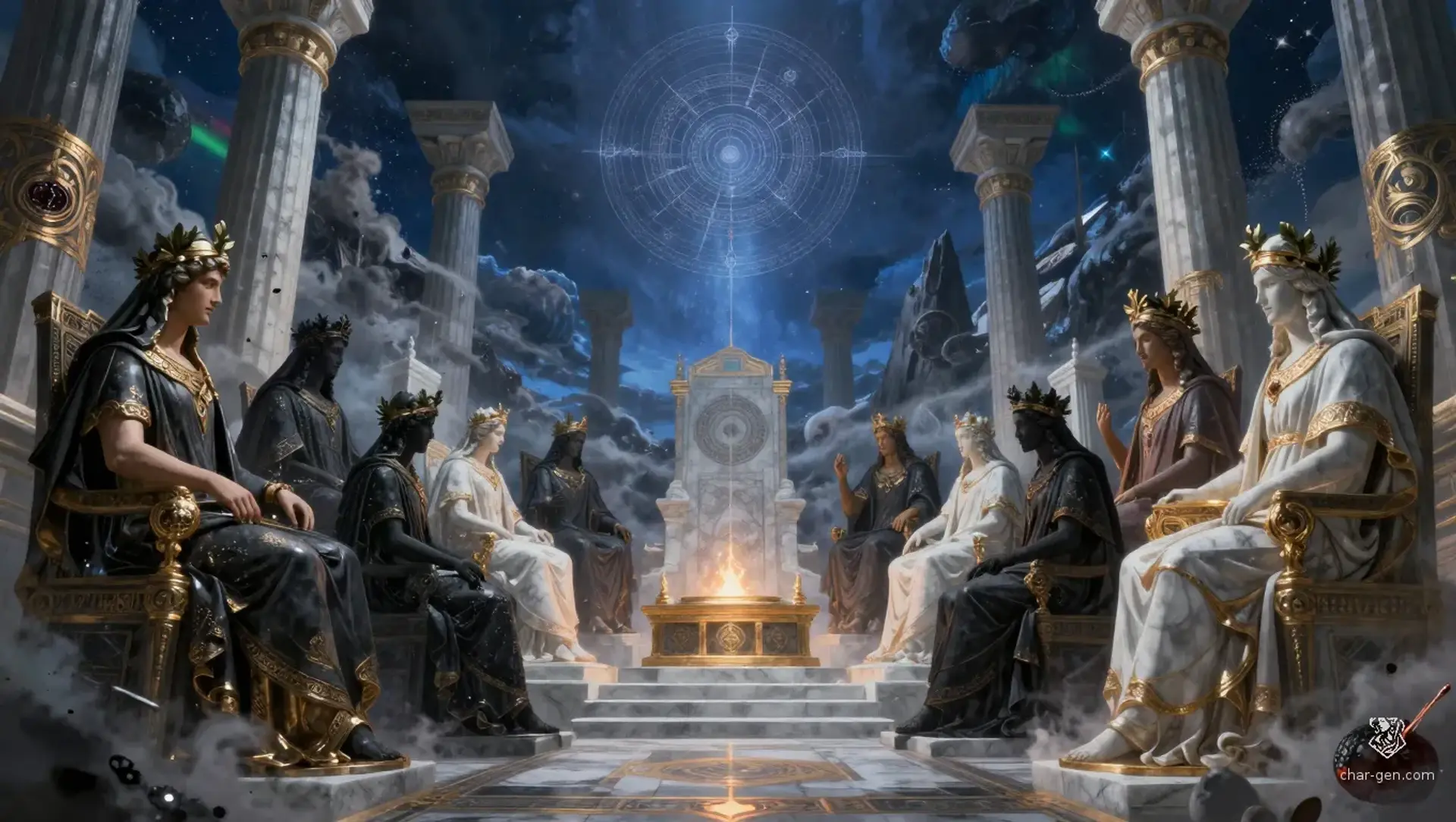
The Twelve Thrones of Olympus
Origin
The pantheon formed when twelve divine powers gathered atop the first mountain after the world emerged from the sleeping Titan. Zeus claimed the sky, Hades claimed the dead, Poseidon claimed the sea, and the remaining thrones were assigned through rivalry, marriage, theft, prophecy, and compromise. Ananke insists the assembly was inevitable; Hermes maintains that the meeting occurred only because he forged the invitation.
Cosmology
The world rests upon the back of the First Titan, whose sleeping thoughts became sea, earth, sky, and mortal dreams. Above the world stands Olympus, a remote citadel of cloud and marble. Beneath it lie the mortal realms, the sea-roads of Poseidon, and the underworld of Hades. Ananke, older than the assembled gods, binds every realm with invisible necessity, though Hermes claims there are paths even fate cannot see.
Structure
The religion is a loose network of city temples, household shrines, mystery cults, traveling priesthoods, and civic festivals. Each city elevates one deity as patron but recognizes the entire assembly. Major temples are arranged around a central open court called the Concord, with twelve empty thrones representing divine distance. Priests specialize in one god yet study the rites of all twelve, since disputes between deities are considered sacred precedents for mortal law. Mystery traditions dedicated to Persephone, Dionysus, Hades, and Ananke promise deeper truths, though their teachings often contradict one another.
Mortal Relations
The gods rarely answer prayers directly. Their temples are distant institutions, their priests interpret omens rather than receive daily instructions, and divine interventions tend to arrive as weather, coincidence, dreams, or impossible opportunities. Mortal societies usually honor a civic patron while privately maintaining household rites to several deities. Clerics and champions may serve one god, but the pantheon assumes that every mortal life crosses the domains of many.
Afterlife
The dead ascend the Stair of Clouds, where Heraion weighs their bonds, Ananke measures their choices, and Hades receives them into one of three distant realms: the Radiant Court for the honored, the Quiet Fields for the content, and the Chthonic Deep for the oathbreakers. Hermes guides souls between these realms, while Persephone decides whether exceptional spirits may return to mortal life.
Turn The Twelve Thrones of Olympus into a sheet
A high-res, share-ready sheet you can post or print.