
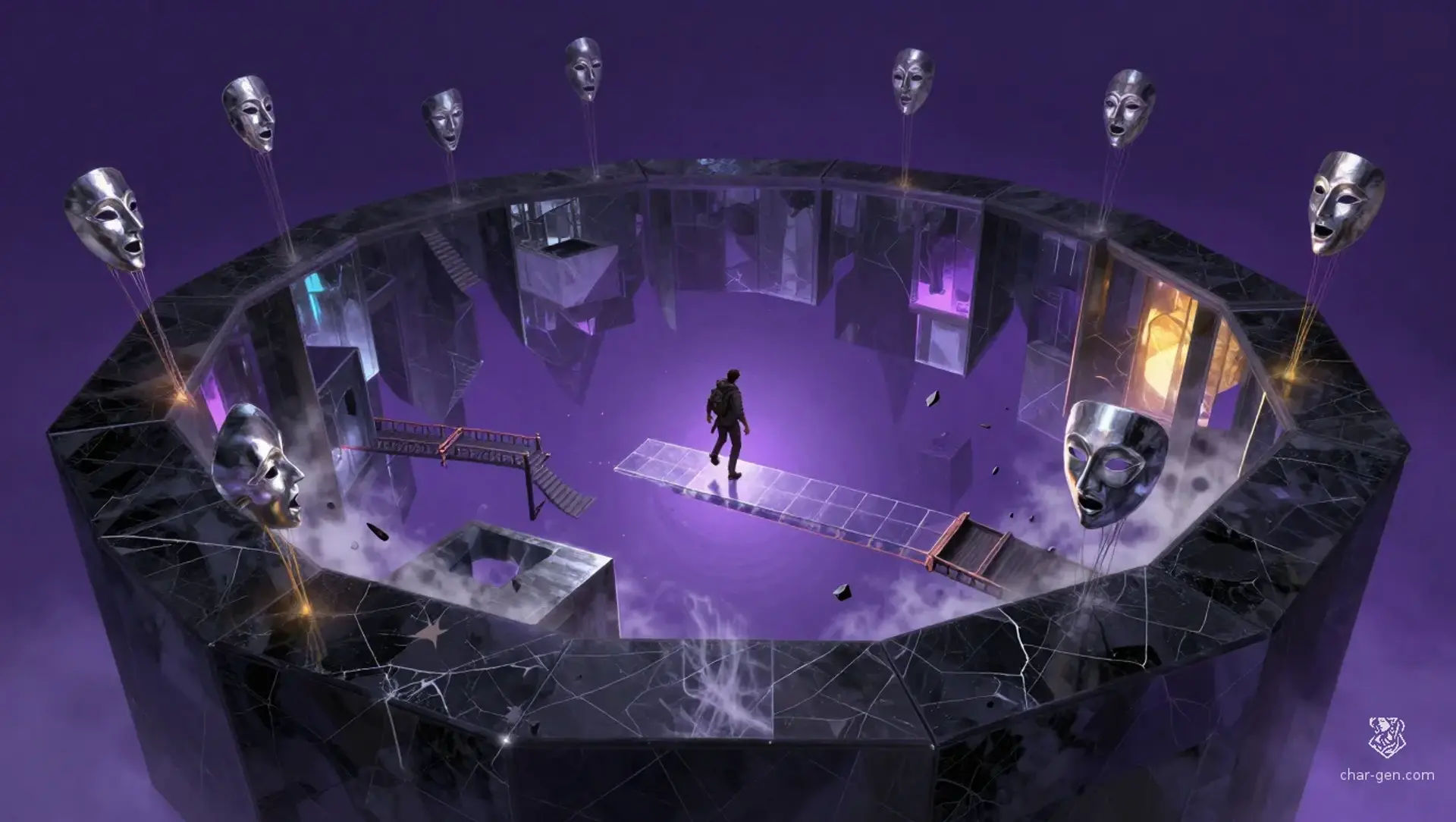
Mirage Crucible
The Mirage Crucible is a planar illusion engine woven into the arena itself. It alters the apparent and physical layout of the battlefield, causing sections of terrain to become false, inverted, distant, or catastrophically unsafe. Unlike a simple illusion, the Crucible creates convincing sensory and tactical consequences. A creature can step onto a bridge that is not there, attack through a wall that only seems solid, or find that the apparent floor has become a vertical surface leading toward the void.
Mirage Crucible
Defenses
Detection
“The arena is a vast octagonal platform suspended over a starless void. Its floor appears to be black marble, but reflections move a heartbeat late, showing bridges, pits, stairways, and distant landscapes that do not exist. At the arena's edges, eight silver masks hang in the air, each whispering a different version of the battlefield.”
Standard Engagement
The hazard activates when a creature enters the arena, attempts to damage the Illusionist, or touches an anchor mask. It remains active until disabled or destroyed.
On its turn, the Mirage Crucible uses 3 actions. It can use each action only once per turn, and it cannot use the same option more than twice in succession. The Crucible chooses three different terrain zones within the arena and assigns each one a new form from the terrain states below. Each zone is a 15-foot-by-15-foot area. The Crucible can select areas within 120 feet, and the zones do not need to be adjacent. After changing terrain, it uses Contradictory Space against each creature currently occupying a changed zone. Once per round, the Crucible can also use Fractured Terrain against a creature that willingly moves into a false ledge or apparent opening.
The hazard resets after 10 minutes if at least one anchor mask remains intact. Any destroyed mask reforms after 24 hours unless the arena's planar foundation is also disrupted.
A creature that enters a false ledge, false bridge, or apparent opening must attempt a DC 36 Reflex save. On a failure, it falls through the illusion into a nearby safe space, takes 6d10 bludgeoning damage and 4d10 mental damage, and lands prone. On a critical failure, it instead falls toward the arena's planar boundary, taking 10d10 bludgeoning damage and becoming immobilized at the edge until it Escapes against DC 38. On a success, the creature catches itself and lands prone at the boundary of the zone. On a critical success, it recognizes the false terrain before fully committing and is unaffected.
When the hazard creates an inverted wall or vertical plane, creatures in the affected area must attempt a DC 36 Reflex save. On a failure, they are pulled 20 feet toward the new plane and fall prone. On a critical failure, they are also pushed 10 feet through the nearest apparent opening and take 4d10 bludgeoning damage. Flying creatures attempt the save only if they are within 10 feet of the shifting plane.
A creature that attacks, casts a spell, or moves through a zone containing a hostile mirage must attempt a DC 36 Will save. On a failure, it becomes off-guard and confused until the start of its next turn as its senses disagree about the arena's layout. On a critical failure, it is also stupefied 1 for 1 round.
At the start of each round, three terrain zones display one of the following states. The changes are visual, auditory, and tactile, but a successful countermeasure can reveal their true nature. Solid terrain provides cover or difficult terrain as appropriate. False terrain is not solid and can trigger Fractured Terrain. Folded terrain connects two visible points that are not adjacent. A creature entering one side exits from the paired side, but must attempt a DC 36 Will save or become disoriented and lose the remainder of its movement. Inverted terrain turns a floor section into a wall or steep surface and triggers Inverted Horizon. Hollow terrain appears solid but is difficult terrain; the first creature to end its movement there must attempt a DC 36 Fortitude save or become sickened 1 as the ground exhales freezing planar mist.
The Crucible can maintain a maximum of six terrain zones at once. When an anchor mask is disabled, reduce this maximum by 1. If the number of existing zones exceeds the new maximum, the Illusionist chooses which zones collapse.
The hazard cannot directly affect a creature that is not within the arena or that is under an effect granting immunity to illusions. It can still alter terrain beneath such a creature, but that creature automatically recognizes the terrain's true state.
If the Illusionist is unconscious, the Crucible continues its routine for 1 round, then repeats its last terrain pattern each round until the Illusionist awakens or the hazard is disabled.
Turn Mirage Crucible into a sheet
A high-res, share-ready sheet you can post or print.