Skip to content
Create
The Kind Strangers' False Refuge - AI-generated fantasy Hazard

The Kind Strangers' False Refuge

This hazard is a staged refuge in a ruined inn. Humanoids make the room appear recently occupied and safe, then invite travelers inside with friendly voices, claims of shared danger, or offers of food. The baited section of floor gives way when enough weight crosses it, dropping victims into a shallow cellar while hidden attackers rush in to seize packs, water, and other supplies.

Hazard EntryBaited collapse and humanoid ambushLevel1Simple

The Kind Strangers' False Refuge

1LevelUncommonRarityRuined inn, tavern, warehouse, market stall, abandoned home, narrow alley, or partially blocked city streetEnvironment
MundaneBaitedSocialCollapseHumanoid Encounter
Level1
|
HP10
|
AC12
|
TypeBaited collapse and humanoid ambush
|
ComplexitySimple
|
RarityUncommon

Defenses

AC12
HardNot applicable
HP10
BT At 0 hit points, the hazard collapses and can no longer be triggered.
Fort+Not applicable
Ref+DC 12 Dexterity saving throw against the collapsing floor
Will+Not applicable
Immune
poison, psychic, conditions, damage from nonmagical attacks, except damage dealt to the supporting rope or floorboards
Resist
The floorboards and rope are resistant to damage from piercing attacks that do not target a specific support.
Weak
The rope can be severed or pinned., The floorboards are weak against fire damage., The humanoids are easily frightened if their escape route is blocked or their supplies are threatened.
MundaneBaitedSocialCollapseHumanoid Encounter

Detection

PerDC 12 Wisdom (Perception) check to notice the concealed rope, boot scuffs behind the bar, dust shaken from one section of floor, or a gap beneath the cellar door. Characters who specifically inspect the floor or question the occupants about who prepared the room have advantage on the check.
StlThe trap has a passive DC 12 to notice before it is triggered. The humanoids use Dexterity (Stealth) checks contested by the characters' passive Perception.
InitThe humanoids have advantage on their first initiative check if the characters have not detected the setup.

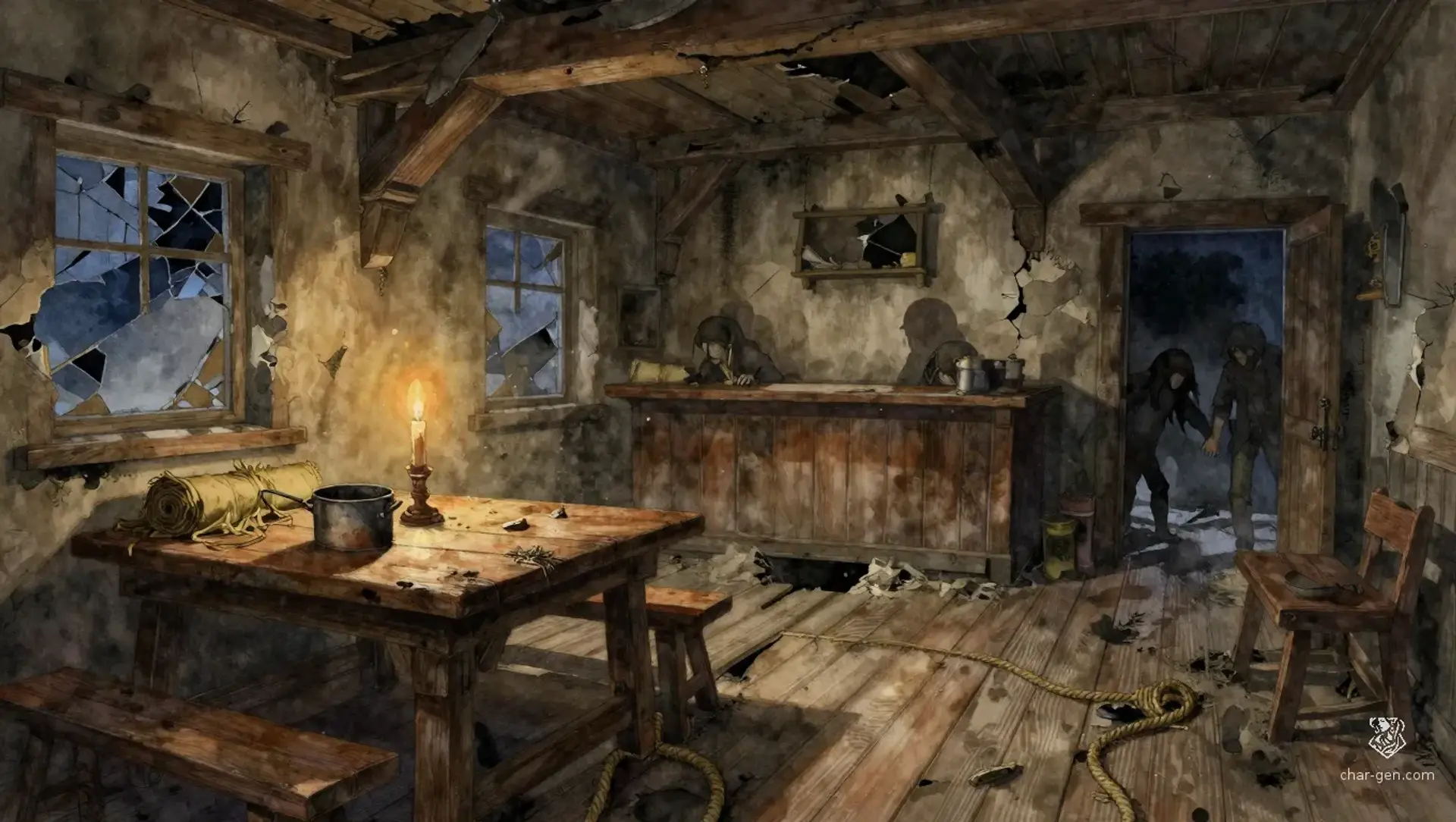
A half-collapsed common room in a ruined inn, with a mostly intact table, several bedrolls, and a cooking pot placed where travelers can easily see them. A frayed rope runs beneath loose floorboards toward a concealed position behind the bar.

Standard Engagement

Trigger

The trap triggers when one or more creatures weighing at least 50 pounds cross the weakened floor section after the hidden humanoid pulls the rope. The humanoids usually wait until at least two creatures are in position.

Routine

The humanoids maintain a low fire, arrange a few supplies in plain view, and call out friendly invitations. If approached, one speaker remains visible and offers a believable story, while the others hide nearby. Once a target steps onto the baited section, a hidden humanoid pulls the rope. The group then shouts demands, throws debris, and attempts to drag isolated creatures away from the opening.

Reset

The hazard can be reset after 10 minutes if the humanoids replace the boards and retie the rope. If the humanoids flee, the weakened floor remains dangerous and collapses once more if it is repaired poorly.

Collapsing Floor

When the trap triggers, creatures standing on the baited floor section must make a DC 12 Dexterity saving throw. On a failed save, a creature falls 10 feet into the cellar, takes 1d6 bludgeoning damage, and lands prone. On a successful save, it catches the edge and takes half the falling damage, landing prone at the edge of the opening.

Desperate Ambush

After the floor collapses, 1d4+1 desperate humanoids emerge from behind the bar, nearby rooms, or an adjacent alley. They use improvised clubs, stones, grapples, and threats rather than proper weapons. Their goal is to steal supplies and escape, not fight to the death.

Plausible Desperation

The humanoids use social manipulation before violence. A character who accepts their story without further scrutiny has disadvantage on the first check made to notice the trap.

Break and Bargain

The ambushers are survivors, not trained soldiers. If half of them are incapacitated, if their leader is reduced below half hit points, or if the characters offer food and a credible alternative, they attempt to retreat or negotiate.

Description

This hazard is a staged refuge in a ruined inn. Humanoids make the room appear recently occupied and safe, then invite travelers inside with friendly voices, claims of shared danger, or offers of food. The baited section of floor gives way when enough weight crosses it, dropping victims into a shallow cellar while hidden attackers rush in to seize packs, water, and other supplies.

Discovery

The ruined inn is selected when the hazard appears in a building. Otherwise, the same setup may be arranged across a narrow alley, beneath a tarp-covered doorway, or beside a barricade in the street.

Archival Lore

In the ruined city, an apparently comfortable room is often worth more than an empty one. Small bands learned that travelers are more willing to lower their guard when offered a dry place to sleep, a warm meal, or a sympathetic story about surviving neighbors. The most effective versions leave enough truth in the lie to make questioning feel cruel.

Environment
Ruined inn, tavern, warehouse, market stall, abandoned home, narrow alley, or partially blocked city street
Theme
Desperate survivors and the danger of misplaced trust
Creator
A desperate band of displaced townsfolk, scavengers, and former dock laborers
Purpose
To lure travelers into a vulnerable position, separate or restrain them, and seize their food, water, medicine, and tools.
Game System
D&D 5E
Art Style
Gritty watercolor concept art, ruined fantasy city inn, desperate survivors, practical scavenged traps, muted earth tones, tense candlelit atmosphere
Visual sheet

Turn The Kind Strangers' False Refuge into a sheet

A high-res, share-ready sheet you can post or print.

Gallery

No gallery images yet.