Skip to content
Create
The Scavenger's Falling Stair - AI-generated fantasy Hazard

The Scavenger's Falling Stair

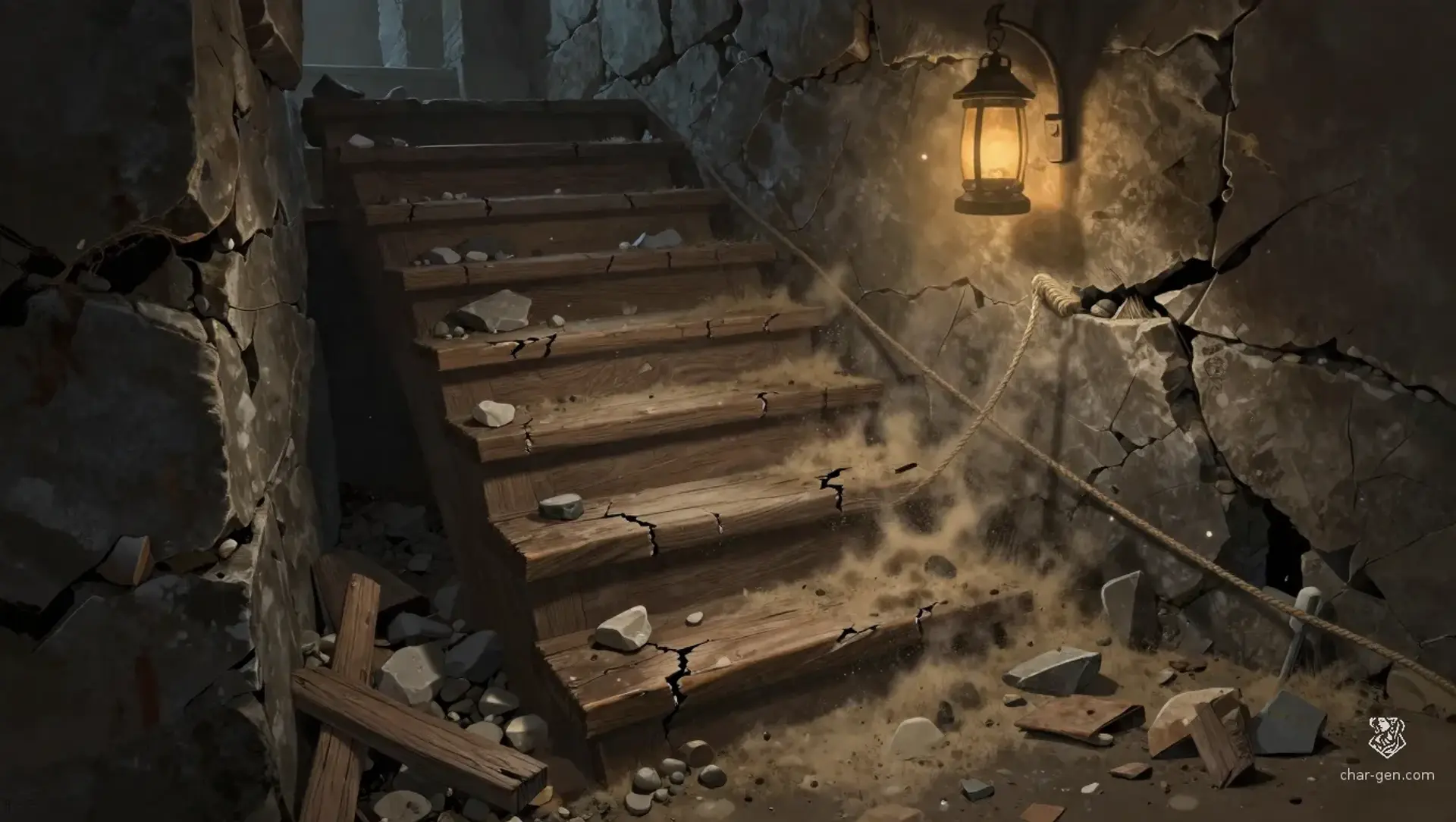
The stairway is not a deadly marvel of engineering. It is a cheap, effective ambush made from rope, scrap wood, and the ruin's own failing structure. When someone catches the cord, a support peg pulls free, causing the upper steps to collapse in a shower of stone and dust. Anyone who falls is left in a cramped lower landing while the survivors above may be cut off from them.

Hazard EntryMechanical trap and environmental collapseLevel1Simple

The Scavenger's Falling Stair

1LevelCommonRarityRuinsEnvironment
MechanicalCollapseImprovisedVisible Clues
Level1
|
HPThe support structure can be destroyed or dismantled. AC 12, 8 hit points, immune to poison and psychic damage.
|
AC12
|
TypeMechanical trap and environmental collapse
|
ComplexitySimple
|
RarityCommon

Defenses

AC12
HardN/A for D&D 5E
HPThe support structure can be destroyed or dismantled. AC 12, 8 hit points, immune to poison and psychic damage.
BT N/A for D&D 5E
Fort+Not applicable in D&D 5E
Ref+DC 12 Dexterity saving throw to avoid the falling rubble
Will+Not applicable in D&D 5E
Immune
Poison damage, Psychic damage, Poisoned condition, Charmed condition, Frightened condition
Resist
None
Weak
Fire can burn through the trip cord, though doing so triggers the trap unless the support is braced first., A creature can jam the falling stones with a crowbar, piton, or similar tool, granting advantage on the initial Dexterity saving throw., The trap is ineffective against creatures that can safely fly or climb around the stairway.
MechanicalCollapseImprovisedVisible Clues

Detection

PerDC 12 Wisdom (Perception) to notice the trip cord and weakened steps. Passive Perception 12 or higher notices the danger while approaching carefully.
StlDC 13. The trap is concealed among ordinary ruin debris and makes no sound until triggered.
InitThe trap activates immediately when triggered. It does not roll initiative. Creatures who notice the trigger can act normally before deliberately setting it off.

A cracked stairway descends through the ruin. Several steps are newer than the others, patched with mismatched boards and loose stone. A thin cord runs along the wall at ankle height, partly hidden beneath dust.

Standard Engagement

Trigger

A creature puts significant weight on the third step or catches the trip cord. The trap also triggers if the support peg is pulled without being safely secured.

Routine

The hazard remains dormant until a creature crosses the trapped section. When triggered, the support peg pulls free, the steps collapse, and rubble falls onto the stairway and lower landing.

Reset

Manual. The trap must be rebuilt with rope, a replacement peg, and several minutes of work. A scavenger familiar with the ruin can reset it in 10 minutes.

Collapsing Stairway

When the trap triggers, each creature on the stairway or within 5 feet of the lower landing must make a DC 12 Dexterity saving throw. On a failed save, a creature takes 2d6 bludgeoning damage and falls prone. On a successful save, it takes half damage and does not fall prone. A creature that fails the save by 5 or more also becomes restrained beneath rubble until it or another creature uses an action to free it with a successful DC 10 Strength (Athletics) check.

Dust Cloud

The collapse fills the area with choking dust. Until the end of the next round, the stairway and lower landing are lightly obscured. A creature that starts its turn in the dust must succeed on a DC 10 Constitution saving throw or be unable to take reactions until the start of its next turn.

Careful Approach

A creature that moves at half speed while examining the stairs has advantage on the check to notice the trap. A creature that dashes across the stairs has disadvantage on that check, if it is allowed one at all.

Chain Reaction

If two or more creatures are on the trapped section when it activates, the DM can choose one creature to make the first saving throw. On a failed save, that creature's fall may force another creature within 5 feet to make a DC 10 Dexterity saving throw or fall prone as well.

Description

The stairway is not a deadly marvel of engineering. It is a cheap, effective ambush made from rope, scrap wood, and the ruin's own failing structure. When someone catches the cord, a support peg pulls free, causing the upper steps to collapse in a shower of stone and dust. Anyone who falls is left in a cramped lower landing while the survivors above may be cut off from them.

Discovery

The trap is discoverable before entry. Characters who investigate the stairway can make a DC 12 Wisdom (Perception) check. The DC is 10 if they examine the steps from the side or search specifically for a tripwire.

Archival Lore

Ruins are full of materials that can be turned into crude traps. Old stairways are especially useful because their supports are already weakened. Locals who know the site often avoid the stairs entirely and use a narrow ledge nearby.

Environment
Ruins
Theme
Improvised survival traps and dangerous ruin infrastructure
Creator
A group of desperate scavengers or bandits looking to slow pursuers without spending valuable ammunition.
Purpose
To delay intruders, separate a group, and create an opportunity for an ambush.
Game System
D&D 5E
Art Style
Grounded dark-fantasy illustration, collapsed stone ruin, improvised rope-and-wood trap, dusty warm light, practical adventuring details, no magic or supernatural elements.
Visual sheet

Turn The Scavenger's Falling Stair into a sheet

A high-res, share-ready sheet you can post or print.

Gallery

No gallery images yet.