
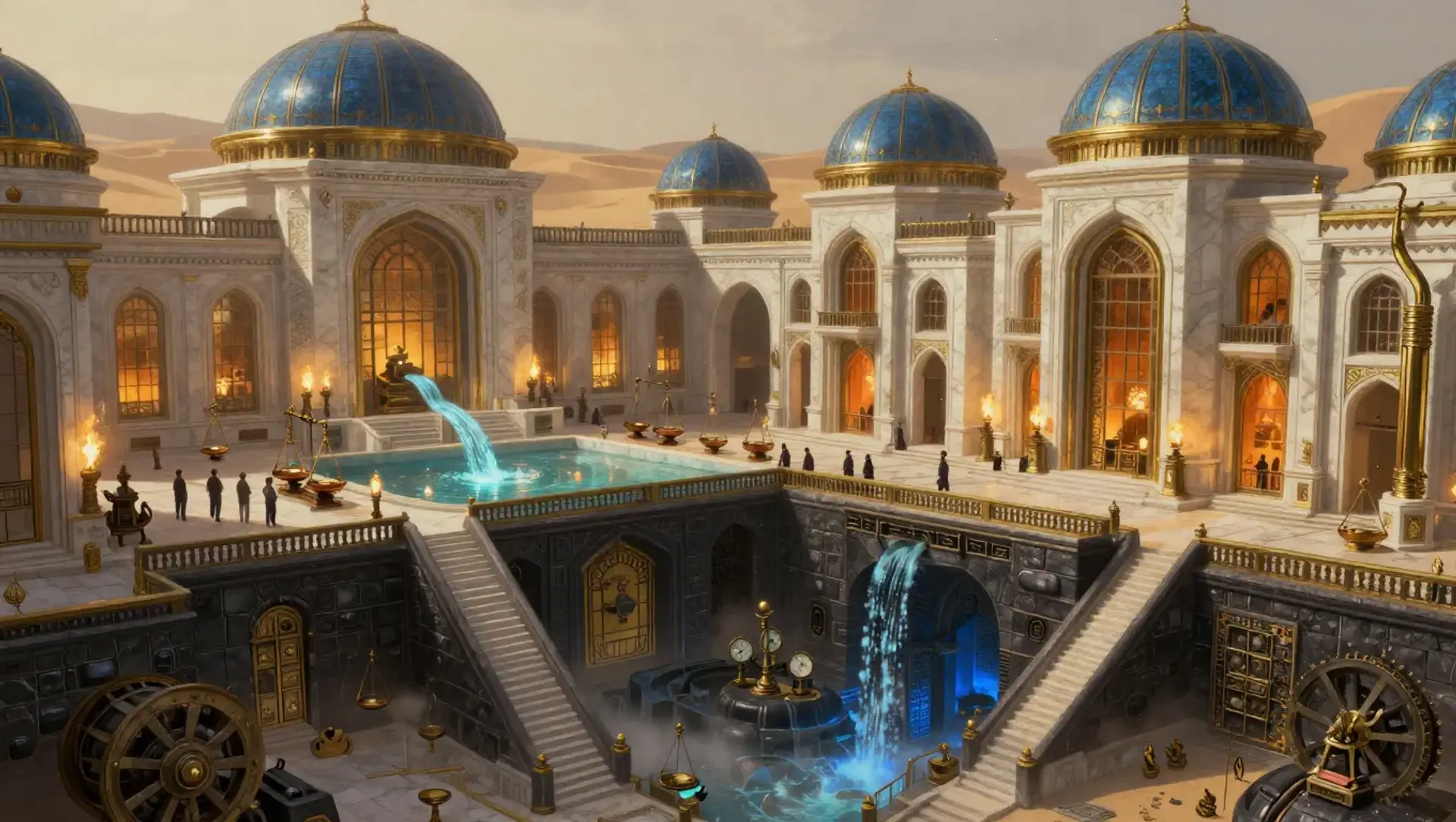
The Rapids Exchange
The Rapids Exchange is the imposing financial, hydraulic, and administrative heart of Verulana's Oasis Consortiums. It rises above the oldest known aquifer in the Sultanate, its public terraces and trading halls designed to display abundance, order, and institutional confidence. Below the surface, the complex descends through fortified archives, collateral vaults, debt registries, and maintenance galleries surrounding the aquifer's high-pressure source. Merchants come to register caravans, settle accounts, secure water rights, and negotiate contracts that can reshape entire city-states. Spies, debtors, smugglers, and ambitious adventurers come for the records hidden beneath the ledgers.
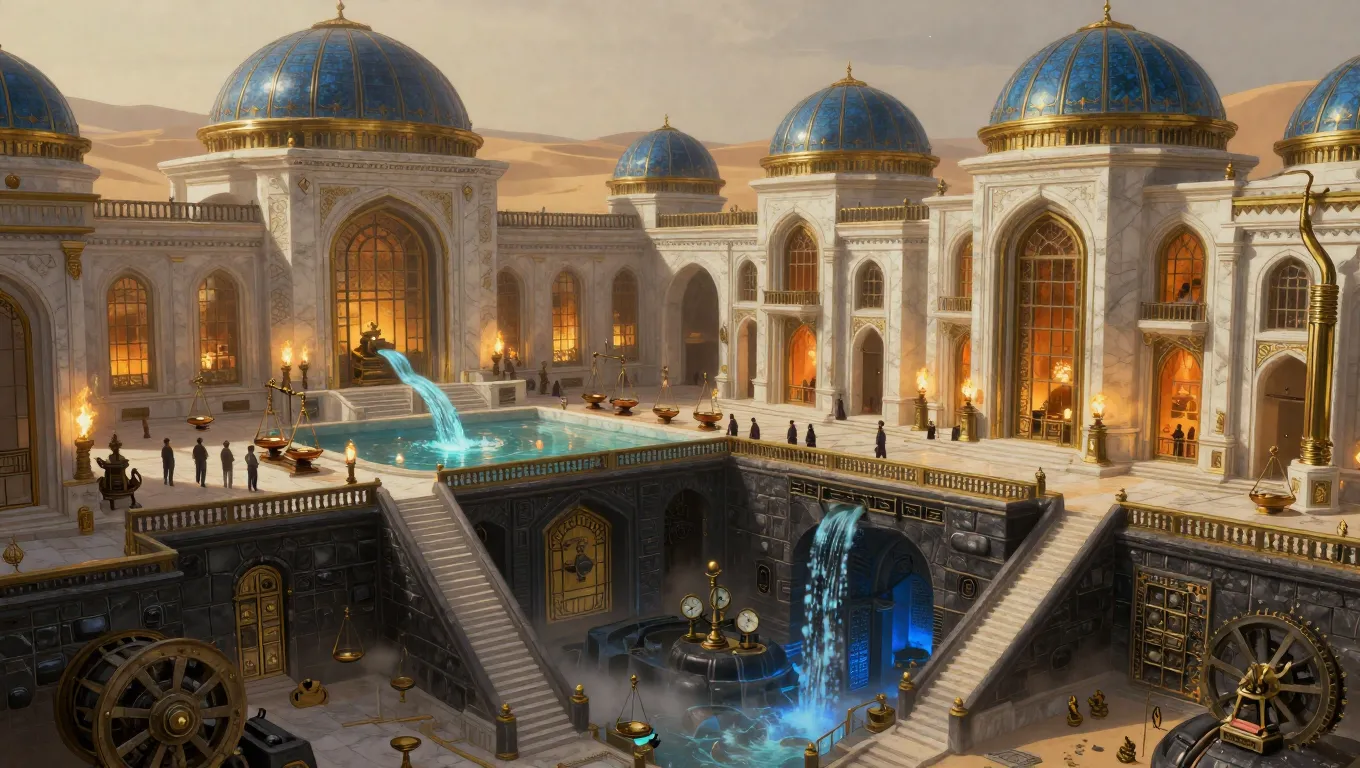
The Rapids Exchange
The upper Exchange smells of cool water, sun-warmed marble, ink, saffron, and expensive perfume. Clerks call numbers across echoing halls while coins clatter into scales and pneumatic tubes hiss overhead. In the Contract Courts, fountains murmur beneath polished arguments, and every pause seems calculated. Far below, the air grows cold and mineral-rich. The steady thunder of the aquifer presses through the walls, joined by the scrape of vault mechanisms and the distant knock of chains. The building feels prosperous, disciplined, and quietly predatory, with every courtesy concealing a price.
The Rapids Exchange is the imposing financial, hydraulic, and administrative heart of Verulana's Oasis Consortiums. It rises above the oldest known aquifer in the Sultanate, its public terraces and trading halls designed to display abundance, order, and institutional confidence. Below the surface, the complex descends through fortified archives, collateral vaults, debt registries, and maintenance galleries surrounding the aquifer's high-pressure source. Merchants come to register caravans, settle accounts, secure water rights, and negotiate contracts that can reshape entire city-states. Spies, debtors, smugglers, and ambitious adventurers come for the records hidden beneath the ledgers.
Collectively cautious, ambitious, polished, and fiercely protective of commercial authority. The Consortiums present themselves as guardians of stability, yet each house pursues advantage through layered obligations, selective generosity, and carefully managed scarcity.
History
Districts and Major Areas
The Exchange is divided into five controlled layers. The sunlit Counting Houses handle currency, weights, and foreign trade. The Caravan Registries maintain route permits, cargo seals, insurance bonds, and water allotments. The Contract Courts settle disputes in public chambers where every spoken term is recorded by crystal listeners. Beneath them lie the Executive Reception Chambers, restricted meeting rooms for Consortium signatories and visiting dignitaries. The Black Ledger Vault occupies the lowest secured tier, surrounding the ancient aquifer with debt archives, sealed collateral, and records that could ruin half the merchant houses in Verulana.
Security and Access
Entry is governed by layered commercial protocol rather than a single gate. Visitors present identity seals, declare their business, submit weapons for inspection, and accept a minor divination that confirms they have not concealed a registered debt. The Exchange employs Waterdeep-style security principles adapted to Verulana, including trained guards, animated scales, glyphs of warding, bound water elementals, pressure doors, and clerks empowered to delay or deny access. The Black Ledger Vault is protected by rotating passphrases, false corridors, counterweighted floors, anti-teleportation wards, and a hydraulic lock system that can flood selected passages without threatening the aquifer.
Commercial Services and Adventure Hooks
The Rapids Exchange hosts contracts worth more than many towns. Common business includes caravan financing, water rights, crop futures, mineral charters, debt restructuring, foreign currency exchange, and emergency relief loans. A party may be hired to retrieve a stolen trade seal, expose forged caravan manifests, escort a Consortium negotiator, arbitrate a dispute between rival houses, or determine whether a debtor's memory was magically altered. Every agreement carries practical consequences, and breaking one may trigger bounty hunters, asset seizures, political retaliation, or a formal hearing before the Contract Courts.
Archives and Restricted Records
The Exchange maintains a sealed collection of ledgers dating back to the first Royal Water Charter. These records include original aquifer maps, private debts owed by noble families, wartime supply agreements, and proof of illicit water diversions. The most restricted archive is the First Flow Register, an engraved aquifer survey kept behind three independent locks. Consortium officials claim it is merely historic documentation. In truth, it contains evidence that several modern water charters were granted over communities that were deliberately erased from the public record.
Denizens
Collectively cautious, ambitious, polished, and fiercely protective of commercial authority. The Consortiums present themselves as guardians of stability, yet each house pursues advantage through layered obligations, selective generosity, and carefully managed scarcity.
A tall water genasi with midnight-blue skin and faint gold veins that brighten when she is angry or excited. Talia speaks with measured warmth, remembers nearly every commercial detail placed before her, and treats negotiation as both performance and warfare. She prefers mutually profitable agreements, but she never forgets who tried to exploit the Consortium.
A broad-shouldered human caravan magnate with sun-darkened skin, silver rings on every finger, and a habit of tapping his left thumb against his wrist when calculating risk. Darius is charming in public and ruthless in private. He can arrange guides, forged manifests, or emergency transport, provided the debt is clearly recorded.
A dwarf archivist with copper spectacles, immaculate robes, and a memory for discrepancies that borders on supernatural. She believes records should outlive governments, though she has quietly altered minor entries to protect clerks and displaced families from Consortium retaliation.
A human contract advocate known for a calm voice, precise questions, and an unsettling ability to make powerful clients contradict themselves. He rose from a registry clerk to the Contract Courts through patient study and refuses bribes that would create a precedent he cannot defend.
A water genasi engineer with pale turquoise eyes and stained brass gloves. Heoversees the pressure engines, cooling channels, pneumatic tubes, and emergency flood controls. He is practical, underpaid, and increasingly concerned that the aquifer's rhythm has changed in ways the Consortium leadership refuses to acknowledge.
A discreet half-elf security captain whose polished uniform conceals a network of old scars. She prefers containment over violence and knows every service passage between the public halls and the vault levels. She suspects at least one Consortium signatory is using the Exchange to conceal political assassinations as debt enforcement.
Rumors & Plot Hooks
- 1.A sealed debtor beneath the Exchange has been paying interest for more than a century, though no living clerk can identify the original borrower.
- 2.The aquifer has begun producing water that briefly reflects places far below the city, including chambers that do not appear on any survey.
- 3.A Consortium house is preparing to bankrupt three rivals by releasing proof that their oldest water charters were forged.
- 4.A black-cloaked courier has been entering through the Pneumatic Post at night, using a route that was removed from every current blueprint.
- 5.The Contract Courts possess a crystal recording of a private agreement between Talia ibn-Aswad and a foreign power, and someone is willing to kill to obtain it.
- 6.The Black Ledger Vault contains a list of every person secretly indebted to the Consortium, including judges, generals, temple officials, and members of the royal household.
- 7.A recent series of caravan failures may not be banditry. Someone is altering registry records so entire expeditions lose legal access to water before they depart.
- 8.The oldest vault doors were built to contain something that arrived with the aquifer, not merely to protect money and documents.
Classified Entry
The ancient aquifer is not a passive water source. Beneath the First Flow Cistern lies a pre-Sundering hydraulic leyline conduit that feeds pressure into Verulana's elemental aquifers. The Consortium's founders discovered that the conduit responds to contractual language etched into crystal and began using debt oaths to regulate its flow. Over generations, the Exchange's ledgers became part financial archive and part magical control system. The current pressure irregularities are caused by a hidden clause in the First Water Charter, which is slowly redirecting the aquifer's ley energy toward a sealed chamber below the Black Ledger Vault. Inside waits an imprisoned water elemental intelligence that remembers the communities erased to establish the Consortium's authority. If freed, it could expose the Consortium's founding crimes and destabilize Verulana's water network. If destroyed, the capital's aquifer may collapse into a violent planar surge.
Turn The Rapids Exchange into a sheet
A high-res, share-ready sheet you can post or print.