
Temple of Neptune
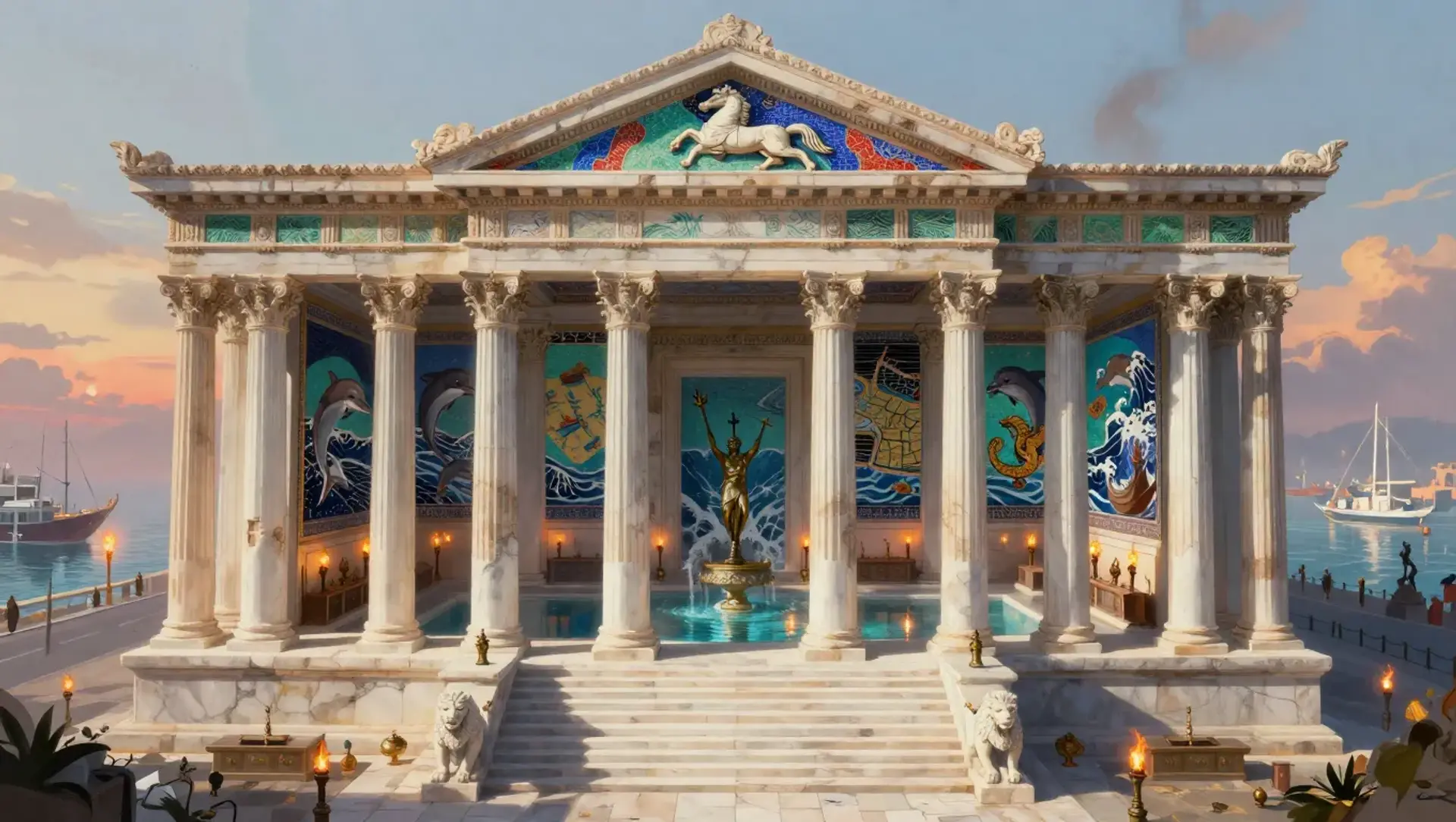
The Temple of Neptune stands on a raised platform overlooking one of Nova Roma’s busiest harbor roads. Its newly restored marble gleams white in the sun, while thousands of blue, turquoise, and black mosaic tiles turn the floors and walls into a frozen sea. The great hall contains rows of votive altars, each marked by offerings from sailors, soldiers, merchants, and families seeking protection from storms, earthquakes, and shipwreck. Fountains and small pools divide the interior into cool, reflective courts, guiding visitors toward the central sanctuary where a bronze statue of Neptune lifts his trident above a basin of constantly moving water. The temple is both a place of worship and a civic symbol, proclaiming that Nova Roma no longer fears the sea, but faces it with reverence and courage.
Temple of Neptune
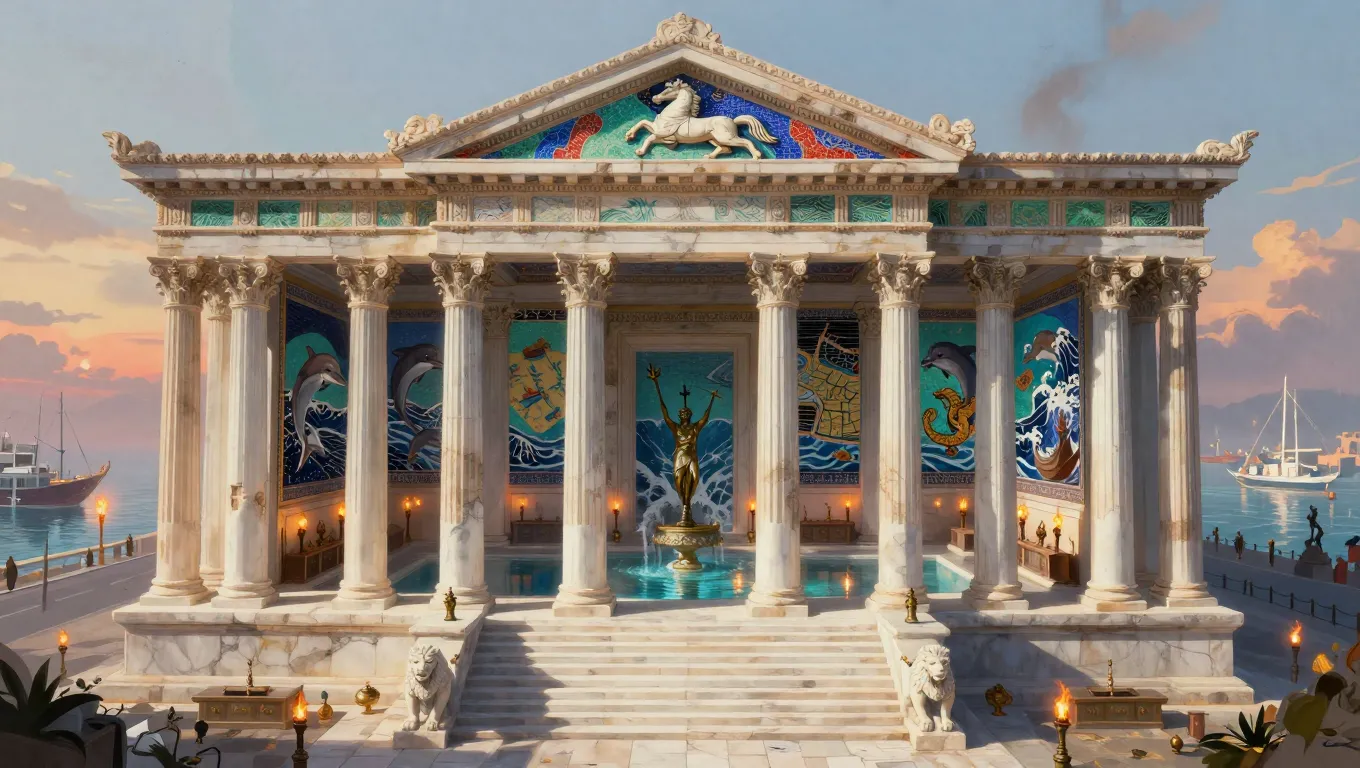
Salt, incense, wet stone, and lamp oil mingle beneath the high ceiling. Water murmurs constantly through tiled channels, spilling from lion-headed spouts into shallow pools where coins glimmer under wavering light. Votive flames flicker in bronze bowls, their smoke twisting beneath mosaics of dolphins, tridents, sea serpents, ships, and dark waves. When thunder rolls over Nova Roma, the entire temple seems to listen, and the pools tremble before the sound reaches the walls.
The Temple of Neptune stands on a raised platform overlooking one of Nova Roma’s busiest harbor roads. Its newly restored marble gleams white in the sun, while thousands of blue, turquoise, and black mosaic tiles turn the floors and walls into a frozen sea. The great hall contains rows of votive altars, each marked by offerings from sailors, soldiers, merchants, and families seeking protection from storms, earthquakes, and shipwreck. Fountains and small pools divide the interior into cool, reflective courts, guiding visitors toward the central sanctuary where a bronze statue of Neptune lifts his trident above a basin of constantly moving water. The temple is both a place of worship and a civic symbol, proclaiming that Nova Roma no longer fears the sea, but faces it with reverence and courage.
Proud, watchful, and newly confident after years of shame. The priesthood welcomes sailors and the poor, but it is fiercely protective of Neptune’s reputation and will not tolerate public mockery of the sea god.
History
Divine Services
At dawn, the priests pour wine, seawater, and olive oil into the central basin while musicians sound bronze horns from the steps. Sailors, fishers, soldiers, and horse breeders bring offerings throughout the day. Before any voyage, captains circle the Great Fountain three times and cast a coin into its deepest pool. During storms, the temple doors remain open, and the faithful gather beneath the portico to pray for calm waters and steady ground.
Sacred Relics
The most sacred object is the Bridle of the Deep, a silver-and-coral horse bridle said to have belonged to Neptune’s first champion in Nova Roma. Its leather has never rotted, though it is regularly soaked in saltwater during the Renewal Rite. A second relic, the Storm Bell, hangs above the inner altar. Its single peal is believed to warn of danger at sea, though only the senior priests are permitted to ring it.
Temple Services and Records
The temple maintains a quiet order of tide-keepers who record ship departures, missing vessels, unusual tides, tremors, and changes in the behavior of horses. Their records are kept on wax tablets in a locked archive beneath the eastern colonnade. Captains often consult the tide-keepers before choosing a route, and the city magistrates rely on their reports when deciding whether to close the harbor.
Restricted Undercroft
Beneath the sanctuary lies an older foundation sealed beneath fresh marble. The priests use it as a place of private confession, ritual cleansing, and emergency shelter during earthquakes or coastal attacks. The lower chambers contain flooded passages leading toward the harbor, but these routes are officially forbidden. Any creature that enters without a priest’s blessing risks disturbing something that has slept beneath Nova Roma for generations.
Denizens
Proud, watchful, and newly confident after years of shame. The priesthood welcomes sailors and the poor, but it is fiercely protective of Neptune’s reputation and will not tolerate public mockery of the sea god.
A former naval commander who helped restore Neptune’s worship after earning glory for Nova Roma. He walks with a carved ash staff, speaks softly, and treats every sailor’s fear as worthy of respect. He believes Neptune is watching the city closely and wants the temple prepared for a coming trial.
A disciplined young priest responsible for the votive fires and the temple’s sacred pools. She can identify the origin of almost any offering and remembers every sailor who has failed to return. Her calm breaks only when someone mistreats a horse or spills blood into a fountain.
A celebrated champion and mortal son of Neptune whose deeds renewed the god’s standing in Nova Roma. He visits without ceremony, often arriving in travel-stained clothes after spending days at the harbor. He is charismatic, physically imposing, and troubled by dreams of a black tide rising beneath the city.
An elderly record keeper who maps tremors, tides, storms, and ship movements on wax tablets. He suspects the recent signs of divine favor are being mistaken for something more dangerous beneath the temple. His fear is practical, not superstitious, which makes the priests reluctant to dismiss him.
Rumors & Plot Hooks
- 1.A fountain in the eastern court sometimes fills with seawater, even when every other basin runs dry.
- 2.Aulus Varro’s victories were not entirely his own. Some claim Neptune demanded a secret price for each triumph.
- 3.The Storm Bell rang once during a moonless night, and a ship vanished from the harbor before dawn.
- 4.A priest found fresh hoofprints across the sanctuary floor after every horse offered at the temple was asleep.
- 5.The restored mosaics include one ancient scene that was not present in the original plans. It shows Nova Roma sinking beneath a crown of waves.
- 6.The temple’s undercroft contains a passage to the harbor, and smugglers have begun searching for its entrance.
Classified Entry
The reconstruction uncovered a sealed chamber beneath the oldest foundation. Inside rests a cracked stone altar dedicated to Neptune, still wet with seawater despite being far above the harbor. The priests have hidden its existence because the altar bears a prophecy describing Nova Roma’s salvation and destruction by the same hand, likely referring to Neptune’s mortal son. Recently, the altar has begun producing low, rhythmic knocks from beneath its surface. The sound grows louder whenever Aulus Varro enters the temple, and something in the flooded undercroft has started answering.
Turn Temple of Neptune into a sheet
A high-res, share-ready sheet you can post or print.