
CharGen vs TabletopArc: D&D Tools Compared in 2026
CharGen vs TabletopArc for D&D in 2026. Compare AI art, VTT tokens, battlemaps, and 17 generators against session transcription and campaign memory.
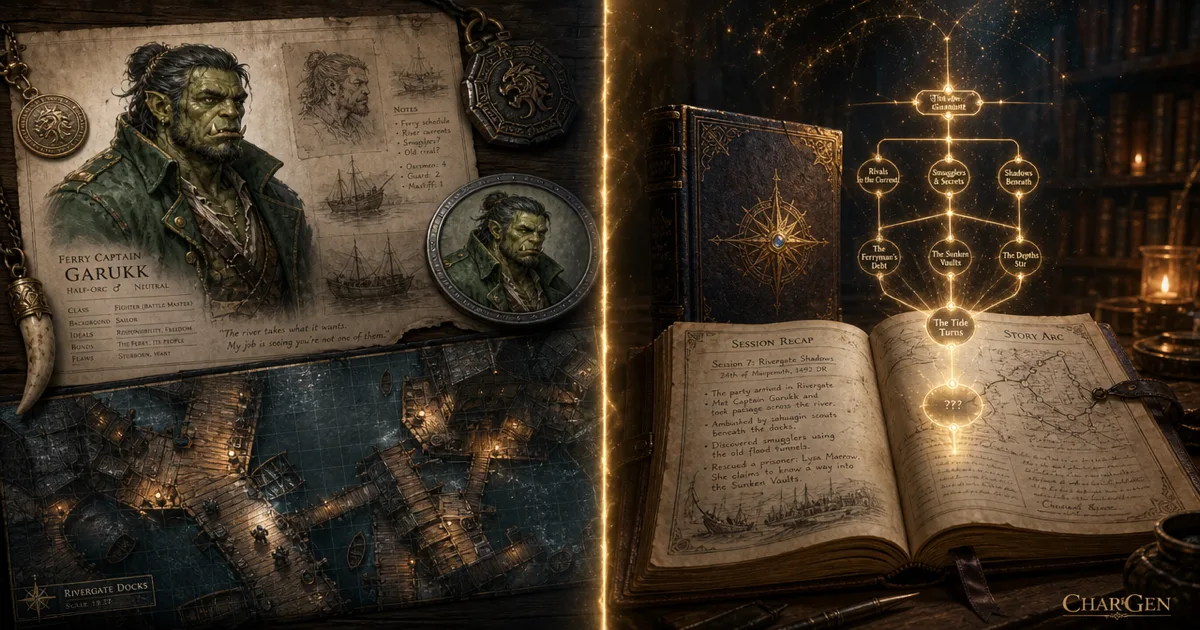
CharGen vs TabletopArc is not the art-versus-memory fight the search results make it look like. TabletopArc runs a comparison page that files CharGen under "visual assets" and keeps campaign prep for itself. That framing is tidy, and it is wrong in one direction: CharGen ships 17 generators, a session summariser, and a campaign codex alongside the art. The honest split is about which end of the table you are trying to fix first: producing the people, places, art, and maps a game needs, or capturing and recalling what actually happened once you sit down to play.
I have used both for real prep, not just clicked around the landing pages. If your recurring pain is that you cannot remember what the party agreed with the duke three sessions ago, TabletopArc is built for exactly that. If your recurring pain is that you need a portrait, a VTT token, a battlemap, and an NPC stat block before Thursday, that is where I reach for CharGen. Both can technically do a bit of the other job. Neither is trying to.
The short answer
TabletopArc calls itself "the AI memory layer for tabletop campaigns". Its centre of gravity is live-session capture: it records and transcribes your session audio, then turns it into recaps, a canon wiki, and searchable campaign memory. Its pricing tells you what the product is really about, because every tier is priced in audio minutes first (30 minutes free, 300 on Pro at $9 per month, 1,200 on Legend at $19 per month, as of July 2026).
CharGen is a creation suite. It advertises 160+ AI models and 70+ art styles, 830,000+ images generated, and 43,000+ creators. It carries 17 generators for names, NPCs, characters, taverns, settlements, regions, buildings, shops, dungeons, loot, magic items, spellbooks, monsters, hazards, factions, poetry, and miniatures, plus dedicated image tools: a Token Maker, a Battlemap generator, party portraits, and a 3D miniature generator. It also has a Session Summariser with a Discord bot and a World Codex for campaign memory, so the "art only" label does not survive contact with the feature list.
| If your bottleneck is... | Better starting point | Why |
|---|---|---|
| Remembering what happened last session | TabletopArc | Audio transcription, recaps, and a canon wiki are the core product |
| Portraits, tokens, and battlemaps before game night | CharGen | Visual production across 160+ models is the core product |
| A free text generator for a quick NPC or quest | Either | Both offer free no-signup entity generators |
| One place for art plus 17 kinds of entity | CharGen | Breadth of generators sits next to the image tools |
| Turning four hours of table talk into notes | TabletopArc | Its whole tier system is measured in audio minutes |
| A VTT-ready token from a fresh portrait | CharGen | The Token Maker is built for the portrait-to-tabletop handoff |
Pick the bottleneck, then pick the tool. Do not subscribe to a transcription product because you liked one NPC it made, and do not choose an art suite if the thing killing your Sundays is session notes.
What each tool is actually built for
TabletopArc's homepage has read the same way for weeks: "where campaigns become stories", built around capturing episodes, preserving canon, and turning play into story arcs. That is a genuine niche, and it is a good one. Plenty of DMs run fine on generators they already have but lose the plot thread between sessions. A tool that listens to the session, writes the recap, and keeps a wiki you can search is solving a real Tuesday-night problem.
Where its marketing overreaches is the CharGen comparison. TabletopArc's own /resources page tells readers to "choose CharGen if your bottleneck is visual assets, portraits, tokens, maps, and fantasy art" and to choose TabletopArc to "build the campaign, not just the asset". Read on its own that sounds fair. Set against CharGen's 17 generators, its Session Summariser, and its World Codex, it is a narrower picture of CharGen than the product supports.
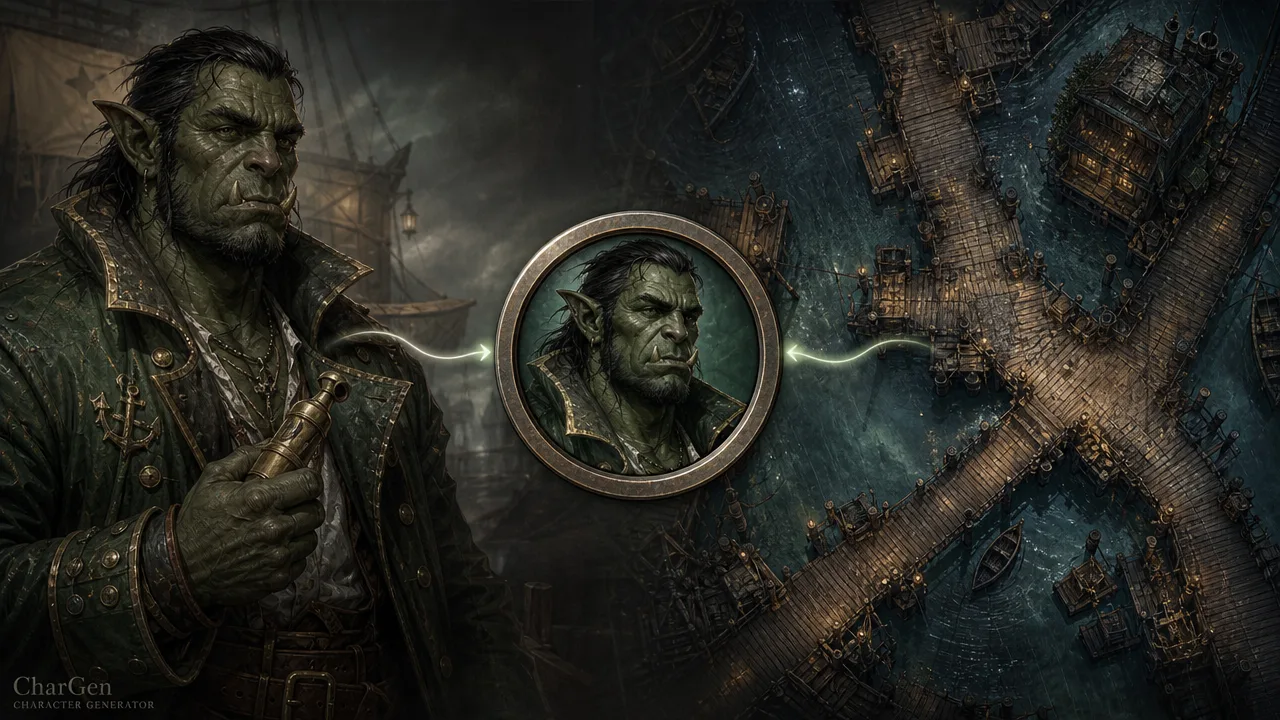
So I would frame it plainly. TabletopArc is a memory-first product with a companion generator suite bolted alongside. CharGen is a creation-first product with session and memory features alongside. The overlap is real, but the thing each one does best is different, and that difference should drive the choice.
Where TabletopArc is the better choice: the session memory layer
Here is the campaign where I would install TabletopArc without hesitation. I run a sprawling political game with a rotating cast, the players take three tangents an hour, and I keep forgetting which noble promised what. I do not want to type notes while I am also running four NPCs and a chase scene.
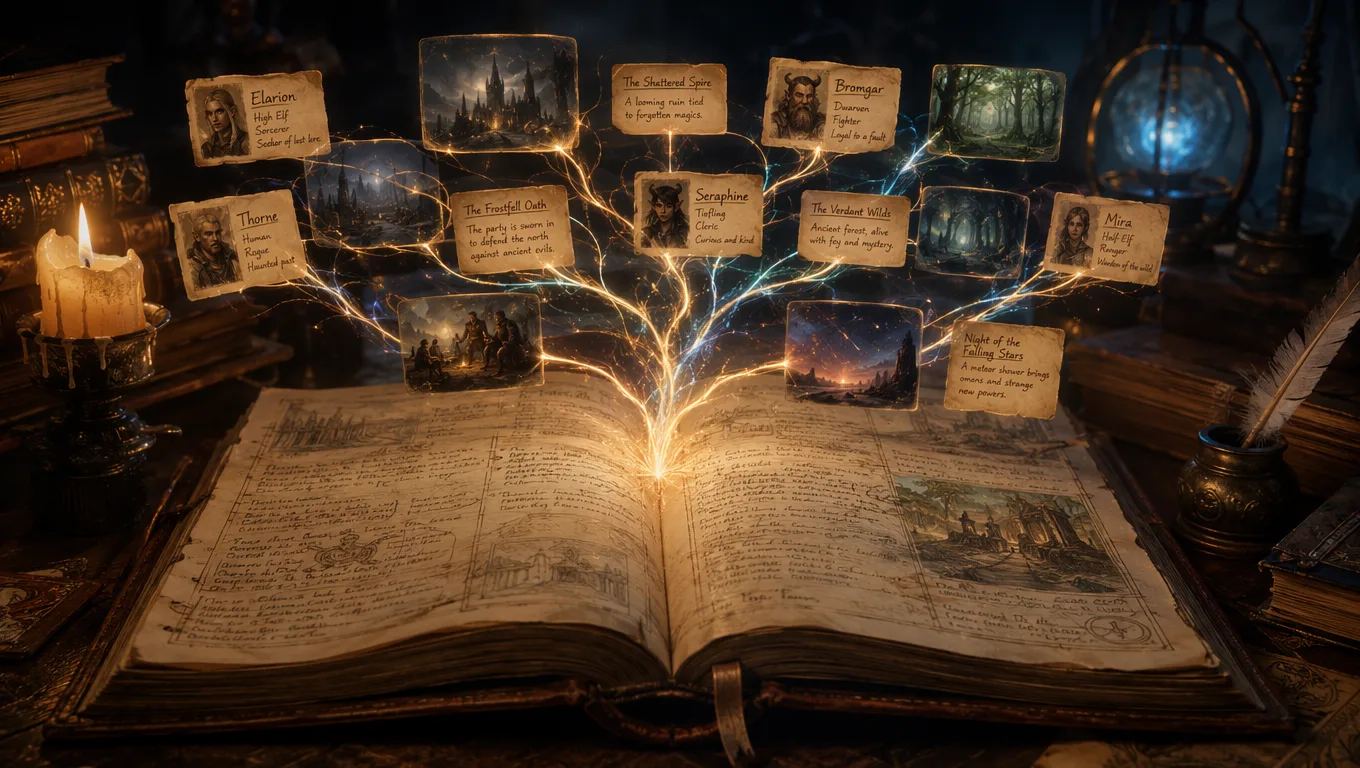
TabletopArc's answer is to record the audio and do the writing for you. The free tier gives you 30 audio minutes a month, which is really a trial rather than a working budget, so a weekly four-hour game pushes you to Pro at $9 per month for 300 minutes, or Legend at $19 for 1,200. In exchange you get a transcript, a recap, and a canon wiki that a later search can actually find. If your single biggest failure mode is continuity, that is money well spent, and CharGen's Session Summariser, which leans on a Discord bot and prep bundles rather than raw audio-minute quotas, is a different shape of the same idea.
TabletopArc also runs a public generator page at /tools with ten free, no-login generators: Battlemap Studio, plus dungeon, NPC, quest, town, encounter, name, tavern, magic item, and plot arc. I tested the NPC generator as a signed-out visitor in July 2026 and it returned a fresh, non-canned NPC with a name, race, class, appearance, personality, motivation, secret, and quirk. That is a genuinely useful free tool, and it overlaps directly with CharGen's own text generators. Credit where it is due.
The honest caution is on the visual side, which is the axis that matters most against CharGen. TabletopArc added image credits across all tiers in July 2026 (10 a month on the free tier, 80 on Pro, 300 on Legend) and documents a Battlemap Studio that shipped in March 2026. When I tried to generate a battlemap as an anonymous visitor, though, the button produced nothing on two separate days, no map and no error. It may work behind a login or with credits on a paid account. I could not confirm it does the job for a free user, and 10 image credits a month is a thin visual budget for a weekly game either way.
Where CharGen is the better choice: producing the campaign
My other campaign is the messy, asset-hungry one. The party adopts a ferry captain who appeared for five minutes, and now I need a portrait, a token, a place for them on the map, and eventually an NPC entry with the favour the party owes them. This is CharGen's home ground.
I start on Generate with a concrete brief: half-orc ferry captain, weathered green coat, chipped brass whistle, practical expression, rain-soaked dock district. I make the portrait, send the approved one through the Token Maker rather than faking a circular crop in another app, and if the session needs a fight on the docks I generate a battlemap in the same place. The point is not any single tool. It is that the portrait, the token, the map, and the quest that made this person matter all come from one RPG-focused environment, across 160+ models rather than one house style.
The breadth is the argument. When TabletopArc's copy pigeonholes CharGen as art, it skips the 17 generators that turn one idea into a full scene: the settlement, the tavern inside it, the shopkeeper who runs the tavern, the faction they answer to, and the loot in the back room. Both products can chain text entities. Only one of them also hands you the portrait, the token, and the map for every link in that chain, and backs it with 830,000+ images already generated by 43,000+ creators.
Generators, tokens, and battlemaps, head to head
There is a version of this comparison that turns into a 40-row feature grid, and I find those useless. For D&D prep I care about three questions. Can I generate the entity I need right now? Can I make it look like something I can put in front of players? Can I get it into the format my table actually uses?
On the first question, both tools are strong. TabletopArc's ten free generators and CharGen's 17 both spit out usable NPCs, quests, and towns without a subscription. If all you ever want is a quick text NPC, either will do, and TabletopArc's no-login speed is a genuine plus.
On the second and third questions, CharGen pulls ahead, because that is what it was built to do. A CharGen NPC does not stop at a text block: it can carry a portrait, become a VTT token, and sit on a battlemap you generated for the same encounter. TabletopArc's strength runs the other way. Once the session is over, its transcription and recap tools do work that CharGen approaches more lightly. If I had to caricature it: TabletopArc is best from the moment you press record to the moment you write the recap, and CharGen is best from the first idea to the finished, table-ready asset.
Pricing: compare the job, not the headline number
Price comparisons across these two are a trap, because they charge for different things. TabletopArc sells audio minutes and credits: Free at $0 (30 audio minutes, 30 AI credits, 10 image credits, 1GB), Pro at $9 per month (300 minutes, 400 AI credits, 80 image credits, 10GB), and Legend at $19 per month (1,200 minutes, 1,500 AI credits, 300 image credits, 50GB), with cash image packs on top for paid tiers. If your usage is measured in hours of recorded play, that model is easy to reason about.
CharGen is free to start on a gold system: you get 25 gold at signup and 10 more for each daily login, and you can earn extra by commenting, posting, and competing, so consistent players generate well beyond the base. The cost of a generation is shown before you run it and changes with the model and resolution, so I would not flatten it into a fake monthly figure. Paid plans start at £9.17 per month for Plus, with Elite and Ultimate above that for heavier image work.
| Question | TabletopArc | CharGen |
|---|---|---|
| What does the free tier really give me? | 30 audio minutes, 10 image credits a month | Gold to spend on generations, topped up by daily logins |
| What is the paid entry point? | Pro at $9 per month (300 audio minutes) | Plus at £9.17 per month |
| What is it optimised to charge for? | Recorded session time and AI credits | Image generations across 160+ models |
| What is the clearest value test? | Record one real session and read the recap | Make one portrait, token, and battlemap you will use |
Run the smallest useful test on each. For TabletopArc, record one genuine session and judge the recap and the searchable wiki. For CharGen, generate one NPC portrait, turn it into a token, and make the battlemap for that encounter. Judge both on the job you actually need doing, at the size you will show players, not on the prettiest thumbnail on the homepage.
Which should you choose?
Choose TabletopArc if the thing breaking your campaign is memory. Its transcription, recaps, and canon wiki are purpose-built for DMs who lose the thread between sessions, and its free no-login generators are a fair bonus for a fast NPC. Just go in clear-eyed about the visual side: image credits are limited and newer, and I could not get the free battlemap tool to produce a map.
Choose CharGen if the thing breaking your campaign is production. It is the stronger fit when you need character art that becomes a token, a party portrait, a battlemap, and an entity in a wider campaign, across many models and styles rather than one. The 17 generators plus the image tools mean the same idea can become text, portrait, token, and map without leaving the workspace, and the session and codex features cover the recall job at a lighter weight.
Do not pick either because a comparison page, theirs or mine, declared a winner. Take the one real character your next session needs, and make it in both. Whichever tool gets that character to the table fastest, in the form you will actually use, is the right answer for your game.
Create a D&D Character in CharGenFrequently Asked Questions
Is CharGen or TabletopArc better for D&D?
It depends on your bottleneck. TabletopArc is the stronger fit for capturing and recalling sessions through audio transcription, recaps, and a canon wiki. CharGen is the stronger fit for producing campaign assets: character art, VTT tokens, battlemaps, and 17 kinds of entity generator in one place.
Is TabletopArc only a transcription tool?
No. Alongside its session memory layer, TabletopArc runs ten free, no-login generators at its tools page, including NPC, quest, town, and Battlemap Studio. Its pricing is still built around audio minutes first, which tells you where the product's focus sits.
Can CharGen do campaign memory and session notes like TabletopArc?
CharGen has a Session Summariser with a Discord bot and a World Codex for organising campaign entities, so it covers recap and memory work. It approaches this through prep bundles and a Discord integration rather than TabletopArc's audio-minute transcription model, so a DM who mainly needs long-form live-audio transcription may prefer TabletopArc for that specific job.
Which tool is better for VTT tokens and battlemaps?
CharGen, clearly. It has a dedicated Token Maker for converting a portrait into a tabletop-ready token and a battlemap generator, backed by 160+ image models. TabletopArc documents a Battlemap Studio and added image credits in 2026, but visual output is credit-limited and I could not confirm the free battlemap tool produces a map for a signed-out user.
Is there a free way to test CharGen and TabletopArc?
Yes. CharGen is free to start on a gold system topped up by daily logins, and TabletopArc has a free tier with 30 audio minutes and ten free generators. Test each with the same character or session and judge it on the job you need it to do.