
Best DnD Session Summary Tool Options for Busy DMs
The best dnd session summary tool options for 2026, with real per-hour costs, an honest answer on free and no-subscription note takers, and workflow advice.
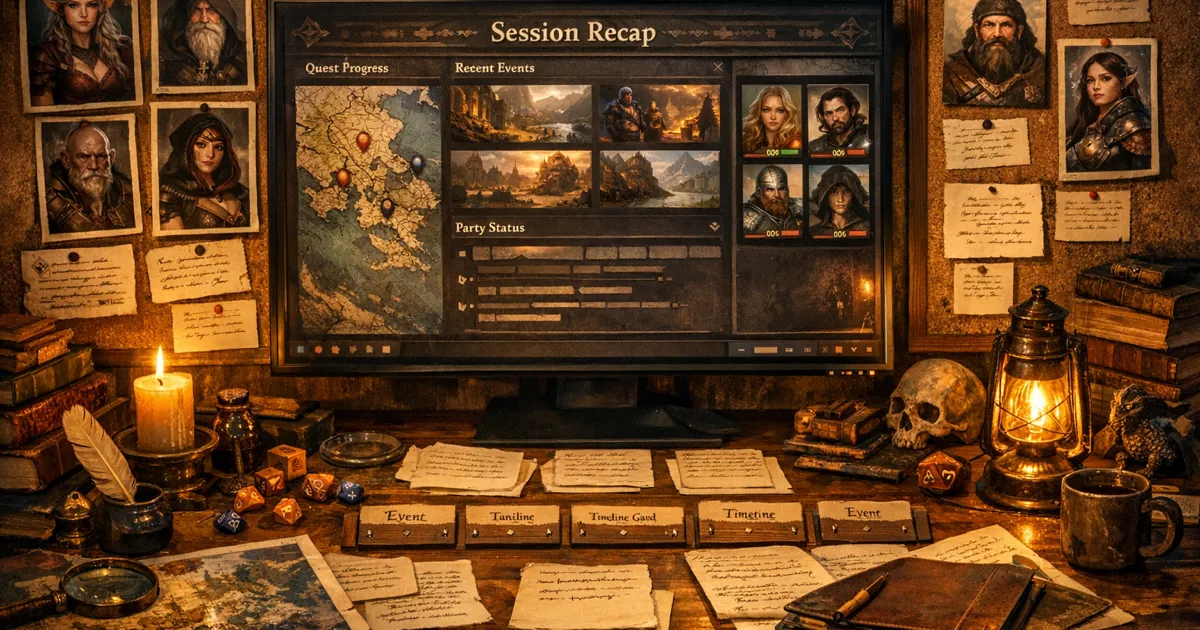
A dnd session summary tool stopped being optional at my table after session twelve of a political city campaign. We had too many names, too many promises, and one player who took excellent notes but missed one week out of three. Once that happened, continuity started slipping. A noble house changed motives between sessions, two NPC voices blended together, and I spent prep night repairing story memory instead of planning the next scene.
I tested several approaches again in March 2026 because tooling moved quickly over the last year and table expectations moved with it. Players now expect clean recaps in Discord, visual references for recurring faces, and fewer "wait, who was that" pauses during play. Fair expectation, honestly. It does mean your summary workflow now needs to do more than produce a paragraph.
Right, so this is a practical comparison for people who actually run weekly games. I am focusing on speed, clarity, and how well each option keeps session notes tied to NPC art and prep assets.
Updated 29 July 2026: I've added a full section on the question I keep seeing asked in recommendation threads, whether there's a free session note taker with no subscription attached, with the real per hour numbers for CharGen and for the main alternatives.
Why this topic matters right now
Two current trends are pushing this discussion. First, D&D Beyond's 2026 release messaging and rules labelling shift have sparked another wave of campaign migrations and mixed-rule tables, which means more recap overhead for many groups. Second, image and media tools keep improving, so DMs are creating more visual material that must stay in sync with notes. Relevant reads: D&D 2026 Calendar Release and OpenAI image update.
I also reviewed recent community conversations in r/DMAcademy, r/DnD, r/dndnext, and r/rpg while planning this post. The same pain points repeat: recaps are either too short to be useful, too long to read before game night, or detached from maps, NPC portraits, and handouts.
Search intent lines up with that. People searching dnd session summary tool are usually trying to solve one of three jobs:
- keep campaign memory accurate when attendance changes
- prep faster by reusing recap facts in encounters and NPC scenes
- share a readable session recap with players without an extra admin hour
Those jobs are practical. They are not abstract writing exercises.
The tools I would actually use in 2026
I narrowed this list to options I can recommend without caveats that waste your prep time.
| Tool route | Best for | Main trade-off | Typical weekly time for recap + prep linkage |
|---|---|---|---|
| CharGen Session Summariser + generators | DMs who want notes, NPCs, and art in one workflow | Needs a clear process to avoid over-editing outputs | 20-35 minutes |
| Obsidian with TTRPG templates | DMs who like manual control and local markdown vaults | More setup and tagging discipline required | 35-60 minutes |
| Notion campaign workspace | Groups collaborating on shared world notes | Easy to drift into heavy admin pages | 40-70 minutes |
| Generic voice transcript + manual cleanup | Fast raw capture after a session | Cleanup burden can be high and messy | 45-90 minutes |
If your table wants one system where recap notes directly influence next-session asset generation, CharGen is the one I would pick first. If your table prefers pure manual writing and local files, Obsidian still works well with enough discipline.
Is there a free D&D session note taker with no subscription?
Yes for a couple of sessions a month, and no for a weekly four hour game unless you run the transcription yourself on your own machine. Every hosted AI note taker meters something, because transcribing four hours of six people talking over dice costs real money to run each time. The useful question is not "is it free", it's how many hours a month you get before you have to pay, and what the bill looks like after that.
This came up in a July 2026 r/rpg thread asking for a free or one time fee auto note taker. The person asking put it plainly:
"I'd prefer something that is either free but capable of running for 4 hours (ideal) or only has a one time purchase, no subscriptions please."
Fair ask, and most roundups skip it, including the earlier version of this post. So here are the actual numbers as of July 2026.
What the no-subscription options actually give you
| Option | Free allowance | Takes a 4 hour session for free? | Cheapest paid route |
|---|---|---|---|
| Whisper, run locally | Unlimited, no account | Yes, no length cap at all | Nothing to pay, MIT licence |
| CharGen Session Summariser | First session free at Pro quality, then about 11 hours a month on login gold | Yes, the free first session ignores length | Plus, £9.99/month |
| D&D Scrybe | First session free, every feature included | Not published | "a simple one-time payment for lifetime access" |
| Otter.ai | 300 minutes a month, 30 minute cap per conversation | No, 240 minutes against a 30 minute cap | Business, $19.99/user/month |
| Archivist AI | 30 day trial, 2 sessions included | Trial only | Casual, $10/month, 4 sessions |
| SessionKeeper | No free tier listed | No | Adventurer, $3.99/month |
Two things jump out of that table. Otter.ai is the name that comes up most when I've seen this asked, and its free plan cannot take a four hour recording at all: the cap is 30 minutes per conversation, and you get three lifetime file imports on top of that. Otter Pro at $8.33 per user per month billed annually still caps a single conversation at 90 minutes. You have to be on Business at $19.99 per user per month before four hours fits in one upload. If your table plays long, most of the "just use Otter, it's free" advice in those threads falls over on the first file.
The second thing: exactly one option there is a genuine one time payment. D&D Scrybe gives you a free first session and then advertises "a simple one-time payment for lifetime access". The figure isn't published on the page I read, so treat it as worth a look rather than a recommendation.
The genuinely free forever route
If you want to pay nothing at all and hold no account anywhere, run OpenAI's Whisper on your own machine. The code and the model weights are both released under the MIT licence, so there's nothing to buy and no cap on how long your recording runs. The large model wants roughly 10GB of VRAM, and the turbo model at 809 million parameters needs about 6GB, which a mid range gaming GPU handles fine.
The catch is that Whisper hands you a transcript, not a recap. Four hours of play comes out as something like 35,000 words of raw text with no speaker labels and no idea which voice belongs to which player. You still have to read the lot and write the summary. For some DMs that's a perfectly good trade, and if I ran one campaign and enjoyed the tinkering I'd probably do exactly that. Pair it with Obsidian, free for personal use, and you have a complete no subscription stack that costs you a Sunday of setup and about an hour of reading after each game.
How far the free tier actually gets you on CharGen
Now the honest bit about my own tool, because a vague "generous free tier" claim helps nobody decide anything.
CharGen meters the Session Summariser in gold rather than seats. You get 10 gold a day for logging in, plus streak bonuses, plus gold from commenting and competitions. The session prices are:
- your first session is free and runs at Pro quality, whatever its length
- audio after that costs 45 gold per hour at Standard, or 100 at Pro, rounded up to the whole hour
- pasting a transcript you already have costs 30 gold per estimated hour at Standard, or 65 at Pro, where an hour is counted as 9,000 words
- files go up to 2GB and 6 hours or more per session, with speaker identification, across 99+ languages
Run that against a four hour game. A four hour audio upload at Standard is 4 times 45, so 180 gold. At 10 gold a day that's 18 days of logging in, which works out at one four hour session every two and a half weeks. Record it yourself and paste the transcript instead and it's 4 times 30, so 120 gold, or 12 days. The free tier lands at about 11 hours of transcription a month either way.
So: genuinely free and subscription free for a fortnightly game, or a monthly one with room spare. Not free for a weekly four hour campaign. Weekly four hour audio needs roughly 774 gold a month, which is the Plus tier at £9.99 for 900 gold and 20 hours. Elite is £19.99 for 2,000 gold and 44 hours, Ultimate £39.99 for 4,500 gold and 100 hours, all listed on the pricing page. There is no one time purchase option, and I'd rather say that here than let you find out after signing up.
Why almost nobody sells this for a one time fee
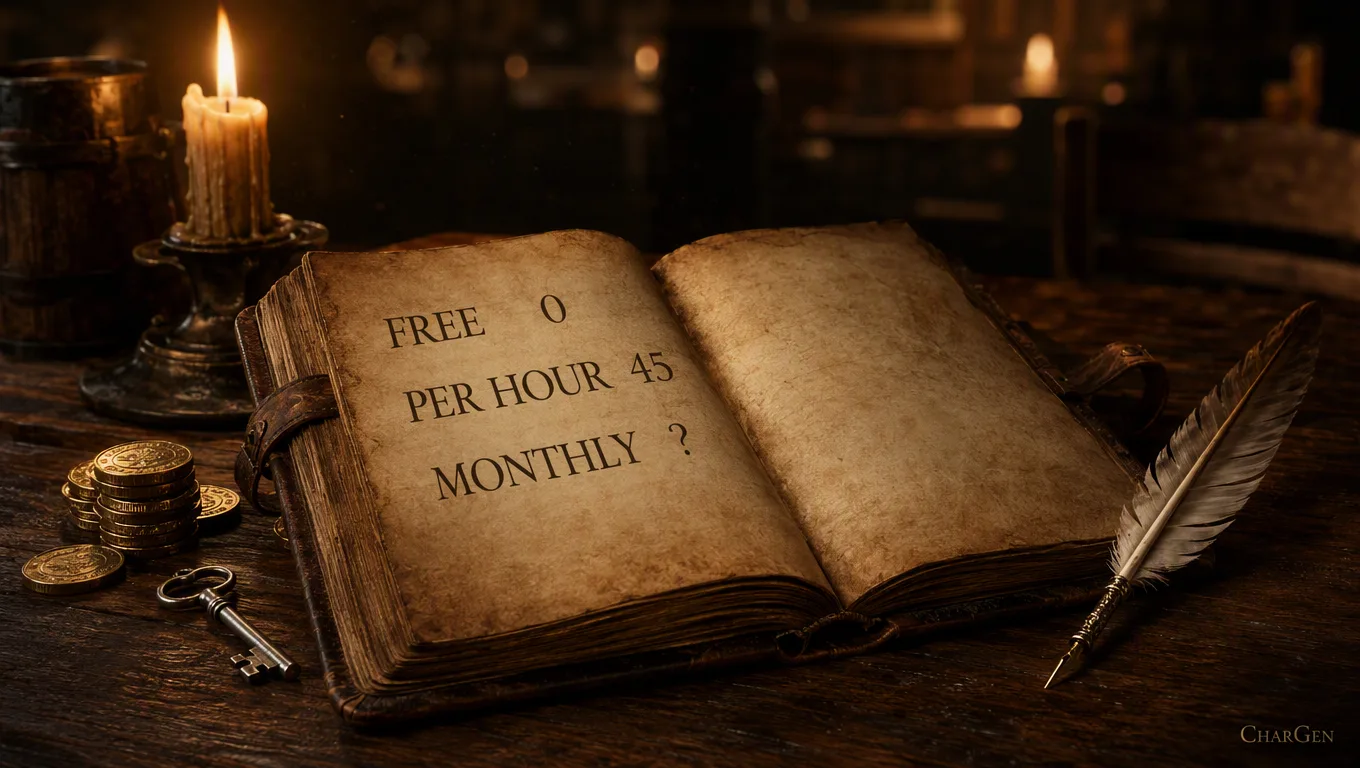
The reason is boring: the cost never stops. One time pricing works when the software runs on your hardware, which is why Foundry VTT can charge $50 once for a perpetual licence and still make sense. Transcription and summarisation burn someone else's GPU time on every single upload, so a lifetime fee set against unlimited four hour sessions is a bet the seller loses.
That leaves three honest shapes. Run it locally and pay nothing but electricity. Accept a metered free tier and stay inside it. Or pay monthly. Anyone promising unlimited hosted AI transcription for one small payment is either capping something they haven't told you about, or won't be around in two years to honour it.
By table type, here's where I'd actually land:
- fortnightly or monthly game, zero spend: CharGen's free tier, and paste your own transcript to make the gold stretch further
- weekly four hour game, zero spend, happy to tinker: Whisper locally plus Obsidian
- weekly game, want the recap written for you: about £10 a month is the floor from any tool, mine included
How to choose a dnd session summary tool for your table
Pick based on failure mode, not feature list. Every DM thinks they need extra options. Most DMs need fewer dropped threads.
Case A: Your players miss sessions often
You need quick re-entry summaries. Prioritise:
- concise recap outputs with named entities
- easy export to Discord or shared docs
- links to key NPCs and unresolved hooks
Concrete example from my table: one player missed session 9 and session 10. A short recap with clear bullets, "what changed", "what matters now", and "who to remember" got them ready in 7 minutes. My old freeform notes took about 25 minutes to parse.
Case B: You prep with lots of NPC visuals
You need summaries and character references connected. Prioritise:
- direct path from recap event to NPC record
- simple way to update visual anchors after story events
- token or portrait export that does not break your file structure
Example: after a failed truce scene, my captain NPC gained a face scar and changed allegiance. When recap and portrait workflow lived together, I updated the note and regenerated the portrait with the new anchor in one short pass. When those steps were split across tools, I forgot once and used the wrong art next week.
Case C: You run a low-tech table and want manual control
You can still do this with markdown and a template stack. Prioritise:
- strict note template per session
- recurring NPC index with one-line state updates
- a fixed "next session prep" block at the bottom of each recap
Manual can be excellent, but only if you keep the template tight.
Where CharGen stands out in practice
Many tool roundups treat summaries as a writing-only problem. In my experience, that is half the job. Weekly prep includes entities, images, and continuity checks. CharGen does better when you care about that full loop.
My normal pattern is:
- run recap in RPG Session Summariser
- update recurring cast in NPC Generator
- generate or adjust art in Image Generator
- build map or scene support when needed in Battlemap Generator
That saves context switching. It also lowers contradiction risk because I am not copy-pasting names between three apps.
There is a useful side benefit for mixed 2014 and 2024 rules tables as well. When session summaries explicitly tag rule assumptions inside the recap, you reduce rules arguments later. I started adding one line each week for this: "Rules baseline for this scene: 2024 conditions + 2014 monster action economy". Arguments dropped fast.
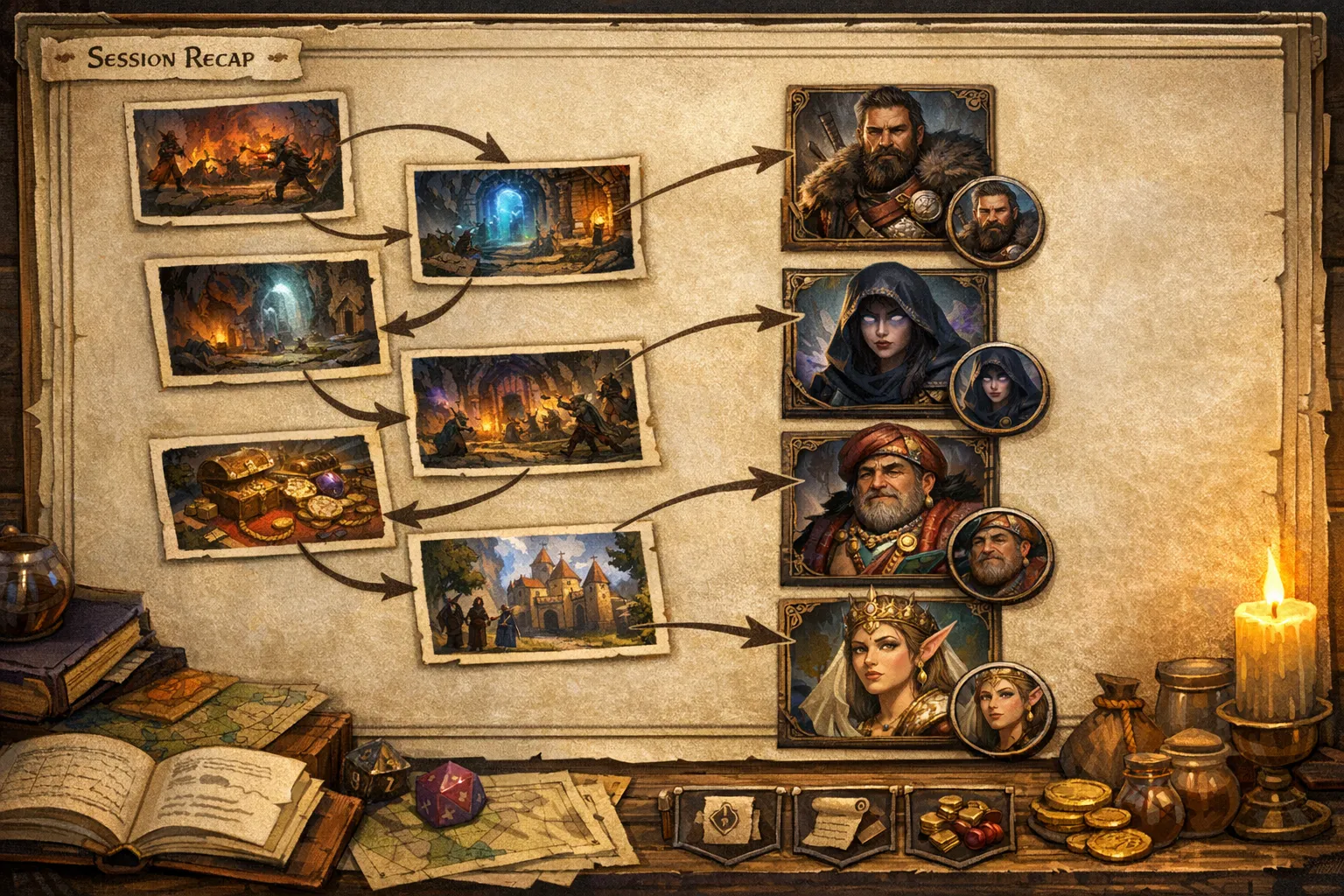
A 50-minute weekly routine that works
I use this for a Tuesday night campaign with six players and an average of two major social scenes per session.
Block 1, 12 minutes, recap generation and trim
Generate a recap draft, then cut it down to five sections:
- key events
- unresolved hooks
- NPC state changes
- location changes
- what the party intends next
If a section is empty, delete it. Empty headers confuse players.
Block 2, 14 minutes, continuity lock
Update only recurring NPCs and only when state changed. I cap this at six records per week.
Real example from session 17:
Sergeant Elowen: now distrusts guild envoys, right gauntlet crackedBrother Cal: public confidence dropped, now speaks through a proxyNymm the Fence: owes the party one favour, moves meetings to river stairs
Those three lines were enough to keep scenes coherent next session.
Block 3, 12 minutes, visual refresh
Try CharGen Session SummariserGenerate only what players are very likely to see next week:
- one location image
- up to three recurring NPC portrait refreshes
- optional one token batch for known combat scenes
I skip visual work for minor bystanders. Players rarely need it and you save time.
Block 4, 12 minutes, player-facing version
Post a short version in Discord:
- 120 to 220 words
- one image
- one "next session focus" line
When recap posts are short and specific, players actually read them.
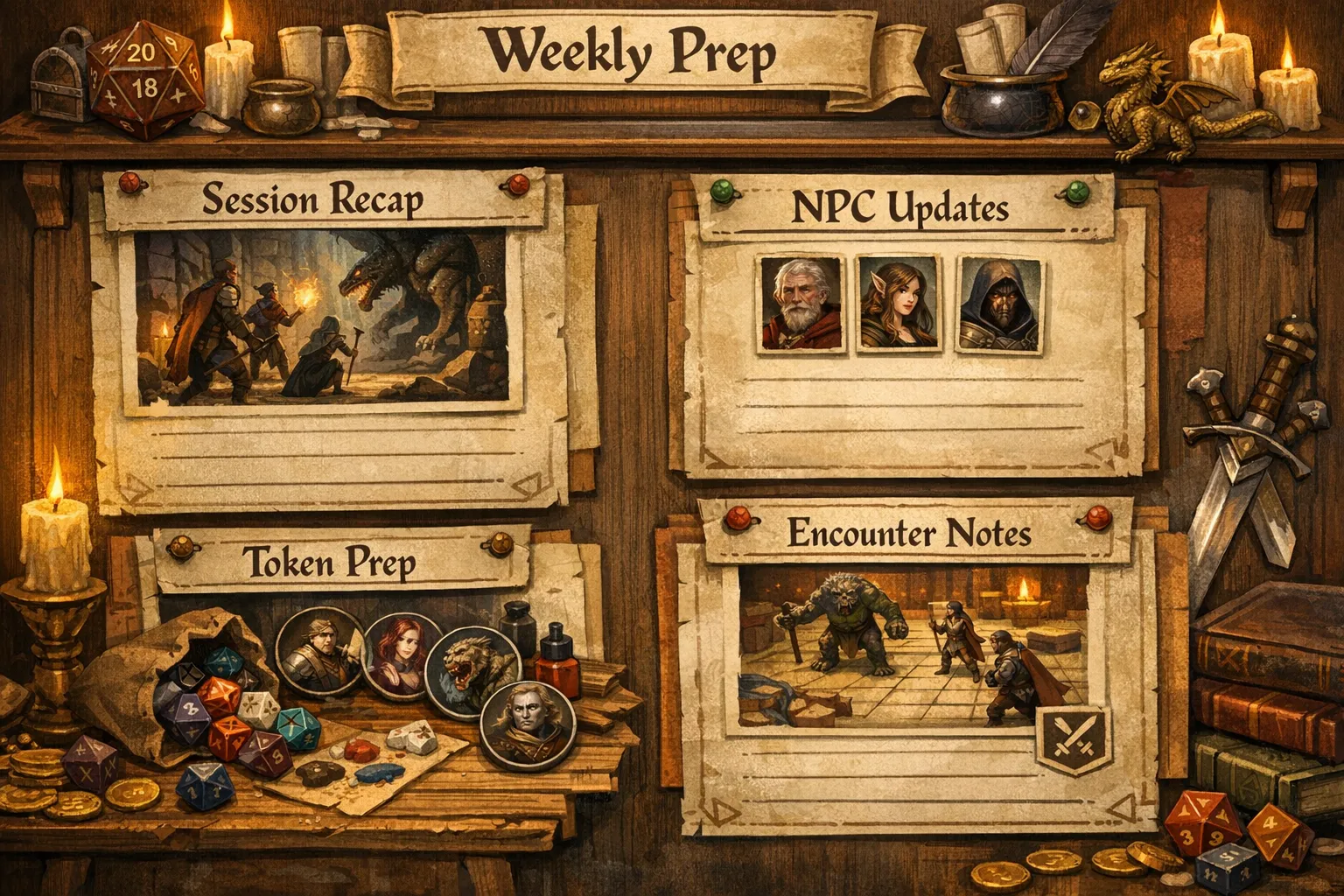
Cost and effort reality check
A lot of posts dodge this, so here is the honest bit. Time cost matters more than subscription headlines.
I track three numbers each week:
- recap + linkage minutes
- number of contradictions found during prep
- number of "who is that NPC" interruptions during session
When those three numbers improve, the tool is doing its job.
In February my average recap workflow across mixed tools was 64 minutes and I still had continuity misses. In March, using a one-workspace flow, average dropped to 33 minutes with far fewer misses. That change mattered more than minor differences in output style.
If you want to measure your own setup, run a four-session test and log only those three metrics. You will get a clear answer quickly.
Common failure points and quick fixes
Failure: recap paragraphs are too long to scan
Fix: keep one sentence per event, then add details as bullet subpoints only when needed.
Failure: NPC names drift between recap and art files
Fix: adopt one canonical display name and one short file-safe id. Keep both visible in your recap template.
Failure: you generate too many visuals
Fix: set a hard weekly cap. Mine is four new assets unless a boss session is coming.
Failure: players ignore recap posts
Fix: post shorter recap first, then optional full notes link underneath. Lead with stakes, not lore.
Failure: session prep still feels chaotic
Fix: add a final checklist line in every recap: "What I must prep before next game". Three items max.
Internal links worth saving
If you want deeper workflows for related tasks, these guides pair well with this process:
- AI Session Notes D&D Workflow for Consistent Campaign Art
- How to Make DnD Tokens Fast for Roll20 and Foundry
- DnD Session Summary Tool + VTT Dice Sync: My CharGen Workflow
What page-one articles often miss
Most ranking pages for this topic still focus on writing quality and template variety. Those matter, but table reliability depends on operational details that get skipped.
Three details I rarely see discussed properly:
- recap freshness window, how soon after session end you publish
- named entity carry-over, whether last session names are pulled into new prep
- visual continuity linkage, whether recap events update portrait and token context
Here is a concrete miss I saw in my own logs. I had a "good" recap from an old workflow, around 500 words, neat formatting, and clear prose. Players liked it. Then session prep failed anyway because two NPCs shared similar titles and I had no state-change line attached to their art records. The recap looked polished but did not support actual play.
When I switched to a recap format with explicit entity state lines, prep errors dropped. I now keep one compact field under every recurring NPC after each game:
last_seen_state: [allegiance] + [visible marker] + [current pressure]
Example:
last_seen_state: neutral-to-party + stitched left cheek + owes debt to harbour guild
That single line prevents many continuity mistakes in social-heavy campaigns.
If you are comparing options this week, evaluate them with a live test: run one recap, then prep next session from that recap alone without checking old notes. If you can do that in under 35 minutes with no contradictions, your chosen workflow is strong enough.
FAQ: dnd session summary tool selection
What is the best dnd session summary tool for a new DM?
If you want the lowest admin load, start with CharGen because recap and generation tools are already in one place. If you prefer manual notes and heavy custom structure, use Obsidian with a strict template.
How long should a player-facing session recap be?
I aim for 120 to 220 words plus one image. That is enough context for returners and short enough for busy players to read.
Should I include every plot detail in the recap?
No. Include only details that change player choices next session. Keep secrets and deep lore in your private DM notes.
How many NPCs should I update after each session?
Only the recurring cast touched by events. Usually three to six updates is enough.
Can I use AI summaries without losing my campaign voice?
Yes, if you edit the final pass. I always rewrite at least the opening and the closing lines so tone stays consistent with my table.
Is there a free D&D session note taker with no subscription?
Yes, within limits. CharGen's first session is free at Pro quality with no length cap, and after that the free tier gives roughly 11 hours of transcription a month from 10 gold a day in login rewards. For unlimited free use with no account anywhere, run Whisper on your own machine under its MIT licence and write the recap yourself.
Can a free tool handle a full 4 hour D&D session?
CharGen takes audio files up to 2GB covering 6 hours or more, and the free first session ignores length entirely. Otter.ai's free plan cannot: it caps a single conversation at 30 minutes, and even Otter Pro at $8.33 per user per month stops at 90 minutes. You need Otter Business at $19.99 per user per month for a four hour conversation.
Is there a one time purchase D&D session summariser?
Very few, because hosted transcription costs the provider money on every upload rather than once at install. D&D Scrybe advertises "a simple one-time payment for lifetime access" after a free first session. Everything else I checked in July 2026 is either metered, like CharGen's gold, or a monthly subscription: Archivist AI starts at $10 a month for 4 sessions, SessionKeeper at $3.99 a month.
How much does a 4 hour session cost on CharGen after the free one?
180 gold as an audio upload at Standard quality, or 120 gold if you record it yourself and paste the transcript. On the free tier's 10 gold a day that's one session roughly every fortnight. A weekly four hour game runs about 774 gold a month, which is the £9.99 Plus tier at 900 gold.
My recommendation after testing these routes
For most weekly campaigns in 2026, I would choose CharGen as the core workflow and keep recap, NPC updates, and art refreshes together. It saves time, lowers continuity mistakes, and makes player-facing recaps easier to ship.
If you want to test it tonight, open CharGen signup, run one recap from your last session, update three recurring NPC records, and post a 150-word summary with one image to your group chat. Do that twice and you will know if the workflow fits your table.
Summarise Your Next Session FreeImage note: visuals for this post were generated with OpenAI image generation via the project automation pipeline.